
Soul Care in the High Desert: How to Turn Your Moab Trip into a Mini Retreat

Updated: Sep 4
Admitting that I desperately needed soul care in the high desert only happened when I was already halfway to Moab.
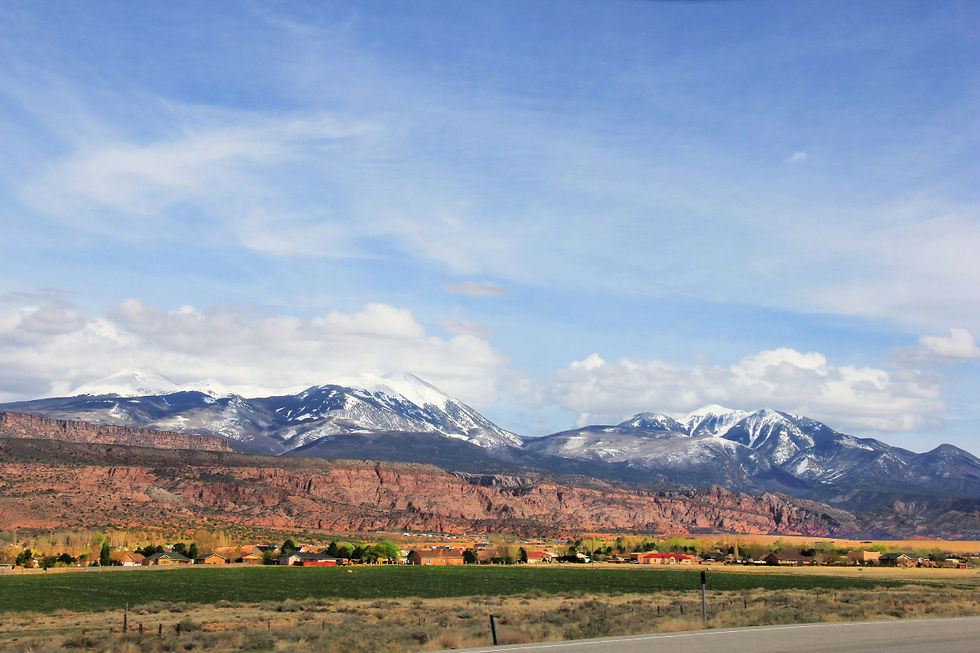
The La Sal Mountains sat behind me in the rearview mirror, blue and steady, while the red rock ahead looked like it had been lit from the inside. The kids weren’t with me this time. No snacks being thrown across the backseat, no arguments over playlists, no questions about how long before we get there. Just me, the road, and a canyon‑sized ache I’d been trying to shake for months.
You know the kind. The ache that waits for you in grocery lines and red lights and those five seconds between hitting your pillow and finally falling asleep. The kind you can’t fix with a new planner, a different podcast, or a long weekend of Netflix.
I’d booked a few nights at Deer Creek almost as an experiment on myself: what would happen if I treated a Moab trip not as an adrenaline buffet but as a mini retreat in Moab—a small, deliberate interruption in the usual noise? No conference, no lanyards, no schedule printed on glossy paper. Just one person, one cabin, and a landscape that had been watching over my life since childhood.
I didn’t come with an agenda. I came with a question:
What happens if I actually let this place have my attention?
Morning: Soul Care in the High Desert from the Porch
The first morning, the cabin was still—the kind of still that makes you aware of your own pulse. I woke before my alarm to that mountain quiet you can feel down to the bone: no sirens, no leaf blowers, just one bird testing a single note and the wind deciding whether it wanted to move.
I made coffee the way I always do, but it tasted different the valley, the majestic mountain peaks in the background. Maybe it was the air, cooler than my kitchen back home. Maybe it was the fact that I didn’t have a screen in my hand while it brewed. Steam curled up from the mug as I stepped onto the porch, boards cool under my bare feet.
Arches and Canyonlands were still shadow shapes in my mind's eye, but the possiblities of visiting the rim of the world was starting to burn. The sky was that washed‑out pre‑sunrise blue that hints at both gentleness and fire.
I didn’t jump straight into Scripture or a reading plan or anything that would look holy in a caption. I just sat.
At first, my brain did what it always does:
Did I answer that email? I should have been kinder in that conversation.I need to fix this, and this, and this…
It took me a while to realize the bench I was sitting on knew none of this. The tree line didn’t care what I’d produced last quarter. The mountain across the way had been doing its slow work long before I showed up with my anxieties.
That was the first surprise: how much soul care in the high desert starts with letting something bigger than you be completely unimpressed with your busyness.
So I started small. One slow breath in. One slow breath out.
Then I opened my journal and wrote a single prompt at the top of the page:
“What am I carrying into today that I don’t actually have to?”
The answers came out messier than I wanted them to. They always do. Half‑sentences, scribbles, arrows connecting things I didn’t know were related: my impatience with the kids, the way my shoulders locked up every time my phone buzzed, the quiet fear that maybe I was missing in my own life while trying to manage it.
The sun cleared the ridge while I was mid‑sentence. Light spilled across the valley. Somewhere a truck shifted gears far below, tiny and distant. Up on the porch, it felt like time itself had exhaled.
I closed the journal and just watched. For once, I didn’t feel like I had to make anything of it.

I let the morning be enough. Take in the air. Be present in the moment. Look across the distant landscape, enjoy the solitude.
The next day, waking to wind and low clouds, the porch felt different. The air smelled like wet dust—like the first minutes after a summer rain, when the earth announces it’s alive. I wrapped my hands around the mug, felt the warmth bleed into the thin skin of my fingers, and wrote a different question:
“What would today look like if I believed I didn’t have to earn my right to rest?”
I didn’t have an answer. But the question alone loosened something in my chest. Sometimes that’s how life is at Deer Creek Retreat, taking that mini retreat works: you don’t get solutions, just better questions and enough space to hear them.
Midday: Letting the Land Push Back (Gently)
I didn’t come to Old La Sal to sit on the porch all day, but true soul care in the high desert meant listening when Moab adventures called my name. Its a call in the the same way it always does growing up in its orbit. There’s a muscle memory to that drive from the mountains down into the desert—watching the trees thin, the color palette shift, the sky widen until it feels almost indecent.
I chose one trail. Just one. Not the hardest, not the Instagram‑famous one I felt pressure to “conquer.” Mill creek canyon had a middle‑distance hike surrounding by rocks and the creek to make it cooler in spots. It had enough rugged terrain to make my lungs earn their keep, just like when I was a kid.
On the way up, my body remembered childhood summers: the smell of sun‑baked juniper, the way sand under my old beaten tennis shoes felt like walking across a bed of flour, the particular quality of heat that’s dry, all angles, and provides no mercy. Ravens traced lazy circles overhead, dark shapes in a hard blue sky, and the contrast of lush green toward the creekbed against the deseret landscape.
As my breathing got louder, another familiar voice chimed in:
You used to fly up this trail. You’re showing your age. You should be bigger, faster stronger, maybe a little fitter that you are.
I felt the old impulse—to push, to prove, to punish myself into some version of worthiness—flare up like the heat mirroring off the rock.
But the canyon said nothing. The land asked no such thing of me. It simply tilted upward and waited to see who I would be on its surface.
About halfway to the left hand swimming hole, I stepped into a thin sliver of shade carved into the rock wall. I dropped my pack, peeled the damp fabric of my shirt away from my back, and let my heart rate bang against my ribs for a minute. Though the creek was trickling about hundred feet away, and you don't drink straight from the creek, the shade felt like mercy.
I drank from my water bottle. Not frantically—just a steady, deliberate stream. The water was lukewarm, electrolytes giving it a faintly fake‑fruit aftertaste, but it might as well have been drawn from heaven.
The thought came, quiet but sharp: This is what you do with your life, too. March into the hottest part of the day with one half‑empty bottle because someone told you it was “just a short hike.”
The notebook would have to wait until I got back to the cabin, but the prompt wrote itself in my head:
“Where am I calling something ‘short’ so I don’t have to admit it’s draining me?”
Years ago, I would have pushed on immediately, determined not to “waste time.” But that day, I stayed in the shade a little longer than my pride liked. I watched ants navigate a crack in the rock with more patience than I usually gave myself.
Then there was the other memory, the one my body keeps filed under “Don’t Repeat This”:
A younger me, on a longer trail, no shade breaks, not enough water. The ground slowly tilting sideways in my vision, my feet catching on nothing, the desperate calculation of how much farther we had before the car, the quietly panicked check of the bottle—half an inch of warm water sloshing at the bottom.
The way my voice got short with the people I loved because I was afraid and didn’t know how to admit it.
Back then, I turned that day into a story about toughness. "I don't need water," “We made it,” I told myself. “We pushed through.”
Now, standing in the shadow of a sandstone wall with a full bottle and a choice, I could see it more honestly: we got lucky. I had confused stubbornness with courage and what could be heat stroke with pushing through.
On this trip, I wanted a different story.
So I didn’t wait until I was dizzy to turn around. I let the view I had be the view that was enough. I walked back down while my legs still felt like mine.
Back at Deer Creek, the cabin door thumped shut behind me with that satisfying, solid sound. Cool air, filtered light, wooden floors that didn’t demand anything more from my calves. I dropped my pack and laughed—not because the hike had been epic, but because it had been honest.
My body was tired in the good way, not the scary way. And somewhere, somehow, my soul had caught its breath, too.
Evening: Soul Care in the High Desert on the Porch

I didn’t grow up with the word “self-examen.” I grew up with front steps and tailgates and porch chairs, where adults would sit at the end of the day and say a lot without saying much. Someone would flick bottle caps into the dirt, someone would comment on the dark color of the sky, someone would sigh in a way that meant more than words.
At Deer Creek, I rediscovered that ritual in a more deliberate way.
The second night, after the heat of Moab and the cool of Old La Sal had each had their say, I took my notebook back out to the porch. The air had that late‑evening softness, like the day had finally unclenched its fists.
I wrote three simple questions at the top of the page:
What today felt like life?
What today felt like drain?
What do I want to carry—or leave—before tomorrow?
I thought I’d write about the scenery, the hike, the way the creek made its way through the canyone. What I’d “settle” for, instead, was a look at the inner me, something I generally run away from.
What felt like life?
– The first sip of coffee before the sun cleared the mountain.
– The sliver of shade halfway up the trail where I actually let myself rest.
– The laugh that surprised me when I almost tripped and didn’t turn it into a reason to be cruel to myself.
What felt like drain?
– That moment I picked up my phone out of habit and felt my heart rate spike before I’d even unlocked it.
– The way I nearly turned the hike into a competition with a younger version of myself who no longer exists.
What did I want to carry?
The honesty.
What did I want to leave?
The scoreboard.
That’s the strange alchemy of finding soul care in the high desert: the bigness of the landscape gives your small griefs and small joys enough room to stretch out without taking over. They don’t disappear. They just find their proper size.
Another night, clouds clung low over the La Sals and a restless wind cut through my jacket. I almost stayed inside. It had been an ugly day—too many thoughts, not enough clarity. My journal pages looked like a tangle.
But I went to the porch anyway, pulled the blanket tighter, and sat in the dim light. I didn’t have questions this time, just a sentence that had been haunting me:
“I am tired of feeling like my life is something I’m late to.”
I wrote it down. Then I let the silence stare back.
Off in the distance, a single car traced the highway, headlights briefly catching the curve of a canyon wall before disappearing. The stars, when they finally broke through the clouds, didn’t hurry. They arrived on their own schedule, unconcerned with mine.
I realized, not in a lightning bolt but in a slow, almost embarrassing way, that the porch wasn’t there to reward my productivity. It existed whether I journaled or not. Whether I had insights or not.
That, too, was a kind of examen: learning that the world doesn’t need my constant effort to keep spinning.
A Simple Daily Rhythm for Your Mini Retreat in Moab
By the third day, a pattern had emerged. Not a rigid schedule, but a rhythm the land seemed to suggest:
Morning – Porch and page I woke without an alarm. Made coffee. Sat outside before checking my phone or social media. Some mornings, I wrote a prompt. Other mornings, I just described what I could hear: wind in the trees, a far‑off engine, a raven’s croak, my own heartbeat slowing down.
Midday – One honest adventure Instead of stacking my day with four different hikes “because we drove all this way,” I picked one. One trail, one river pullout, one scenic drive. Enough movement that my mind had to drop some of its static and make room for breath. Enough challenge that I felt alive, not punished.
Evening – Porch and reflection Back at the cabin, I showered off the dust, changed into soft clothes, and went back outside. I answered the three questions again. Sometimes I added a line of Scripture or a quote that had been trailing me for weeks. Sometimes I just listened to the coyotes and the wind and let that be the only liturgy.
If you want a more concrete picture, here’s what one day looked like:
6:30 a.m. – Wake to pale light. Coffee, blanket, porch. Journal prompt: “What do I actually want from today?” Answer: “To feel my body and not hate it. To notice something small and beautiful. To not rush.”
9:00 a.m. – Drive up to the creek. Walk a short section of trail along the water. Sit on a warm rock, shoes off, toes flirting with the edge. Let the current carry away all the clever things I thought I needed to say to people.
1:30 p.m. – Back at Deer Creek. Simple lunch, long shower. Fall asleep on the couch with a book facedown on my chest.
5:30 p.m. – Short drive on a nearby road, windows down, watching the mountains change color minute by minute.
8:00 p.m. – Porch again. Three questions on the page. One regret. One unexpected gratitude. One plan for tomorrow that is gentler than I would have chosen a year ago.
That’s it. That’s the whole “framework” of this mini retreat in Old La Sal, near Moab, UT. No rigid schedule. Just a commitment, for a few days, to let your time orbit around presence instead of productivity.
Get the Official Moab & La Sal Field Guides
Before you hit the trail in Moab or the La Sal Mountains, download our standalone field guides for instant offline access. Grab the High-Desert Survival Field Guide for our 1-gallon hydration formula, 12:00 PM alpine lightning rules, and slot canyon flash-flood protocols. Pick up the Mountain to Desert Guide for elevation transition strategies, weather shifts, and the complete 10-essential trailhead checklist.
When the Land Starts Asking the Questions
On my last night of that first self‑experiment, the sky over Old La Sal turned that specific kind of red that looks like the earth remembering every sunset it has ever seen. The cabin lights behind me were soft. The horizon in front of me was on fire.
I sat with the notebook open and realized—for maybe the first time in months—I didn’t have many words left.
What I did have were questions rolling quietly underneath everything else:
What if my life at home borrowed this rhythm—just a little?
What if one morning a week became a “porch morning,” even if the porch is a cramped apartment balcony or a quiet corner of a coffee shop?
What if my next trip here wasn’t about escaping my life, but about learning how to live it with less armor?
You can’t live on retreat forever. The laundry still waits. The inbox still fills. Kids still need rides.
But a few days at Deer Creek, built around this simple way of moving through morning, midday, and evening, can hand you a blueprint you didn’t know you were missing. Not a program. A pattern.
Sometimes that’s all a tired soul needs.
A Challenge: Come Test Your Own Mini Retreat
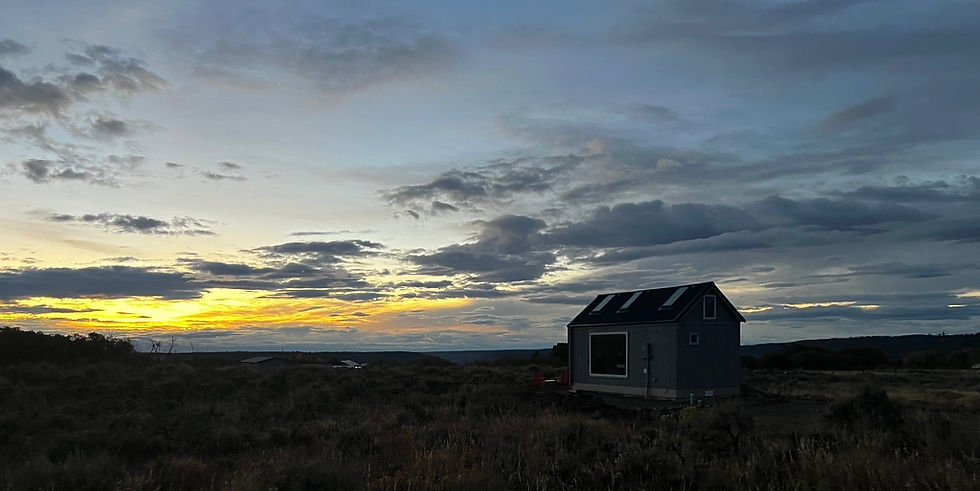
If you’ve read this far, there’s probably a part of you that’s already standing on that porch in your mind—coffee in hand, sky opening up, the day not yet decided.
So here’s the challenge: don’t leave it in your imagination.
Block off a long weekend. Book the main cabin if you want space for family, shared meals, and kids’ art supplies scattered across the table. Book the tiny home if you’re craving something smaller and quieter, a tucked‑in space where you can hear your own thoughts and the deer moving through the sage.
Come build your own version of this rhythm:
Morning on the porch.Midday in the desert.Evening under the stars.
Let the high desert ask you a few questions of its own. Then carry those answers back into the life you’re already living—less frantic, a little braver, a little more awake.
Cheers!
Justin
The Deer Creek Retreat Prep & Field Guide Series
Part 1: Soul Care in the High Desert: How to Turn Your Moab Trip into a Mini Retreat
Part 2: Staying at Deer Creek Retreat: Best Things to Do in Moab and the La Sal Mountains
Part 3: Safety and Heat Prep for Your Moab-La Sal Mountain Retreat
Part 4: Old La Sal Basecamp: Practical Desert Survival Skills for First-Time Moab Visitors
Part 5: First Time Moab Visitor Mistakes (and How a Deer Creek Retreat Basecamp Fixes Them)
Part 6: Family Retreat Between Cabin and Canyon: Helping Kids Thrive in Moab and Old La Sal
Part 7: Planning to Pack for Old La Sal, Utah: Mountain Calm Meets Moab Adventure
🎒 Heading out on the trail? Get field-ready before losing cell service. Download the Moab & La Sal High-Desert Survival Field Guide for critical hydration math, 12:00 PM lightning rules, and slot canyon flood protocols, or pick up the Mountain to Desert Guide for elevation transition strategies and our 10-essential trailhead audit.
About the Author
The author holds a Ph.D. and is an ordained professional chaplain, specializing in the integration of motivation and choice theory, psychological resilience, and pastoral soul care. Transitioning from a ten-year active duty career as a Chaplain in the U.S. Army—where he served within the high-intensity environment of a critical care hospital—his work bridges empirical behavioral science with practical strategies for long-term identity formation. He serves as the primary researcher for grittygritgrit.com, a digital platform dedicated to helping individuals cultivate authentic perseverance through the profound transitions, traumas, and valleys of life. You can explore more of his work and high-mountain-desert writing at deercreeklasal.com.


Comments