
The Gift of Surrender: Dropping Your Guard on the Mountain Porch

Updated: Sep 4
We live in a culture that fundamentally misunderstands the architecture of human connection. We operate under the naive assumption that preventing burnout and emotional exhaustion is simply a matter of expanding our social circles—more meetings, more surface-level check-ins, and more frantic networking. We treat the desire to step away from the crowd as a dangerous warning sign, a slide into isolation, or a selfish retreat from communal responsibility. But to protect our endurance, we must understand that practicing the gift of surrender is not an act of abandonment; it is the exact structural discipline that preserves our capacity to serve others over the long haul. When the phone is turned off and the cabin room goes dark, pulling back does not destroy your capacity for community—it is the exact discipline that preserves it.
Welcome to Act III of The Solitude Lab.
🏔️ Siege of the Isolated Outpost: Unlocking the Gift of Surrender

To speak clearly about the necessity of pulling back, we must first look at how we behave when the terrain gets steep. Anyone who has ever attempted to traverse a high-desert mountain trail or bike an exposed ridge knows that stamina is not a byproduct of frantic pacing. Endurance is determined not by how much of a load you can lift, but by what you carry internally when the landscape goes entirely silent.
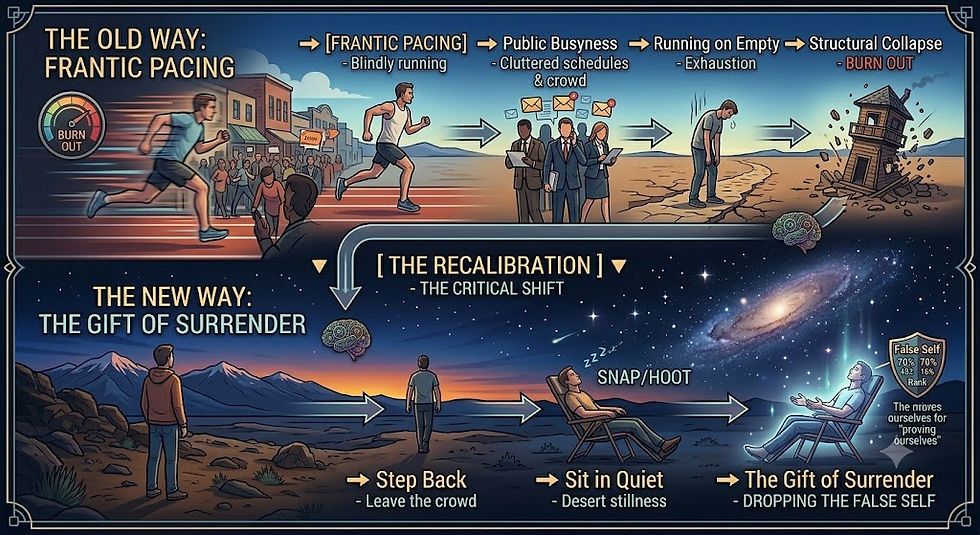
When you are out on an exposed ridgeline in the La Sal mountain air, far above the tree line where the wind shears away all non-essential noise, there is no crowd to perform for. There are no titles, no superficial check-ins, and no immediate feedback loops to sustain your momentum. If a crisis or sudden exhaustion hits you out there, you are instantly stripped down to the raw material of your true identity. You find out exactly what is anchoring you when the external scaffolding falls away.
In our normal, daily routines, we treat public busyness as a badge of honor, running ourselves ragged under the guise of community devotion. But running on empty across a barren stretch of life isn't grit; it is a fast track to systemic failure. True psychological grit does not mean running blindly until you drop. It means having the internal stamina to stop, step back from the crowd, and accept the gift of surrender long enough to let your primary motivations be thoroughly recalibrated.
👽 The Cosmic Perspective: Scanning a Low-Pollution Sky
If your mind struggles to make the transition from frantic activism to absolute stillness, a shift in environment is often the catalyst. At Deer Creek, the deep-black sky offers an elite, low-pollution vantage point entirely unmarred by city light domes. It reveals a blanket of stars so blindingly visible, moving, and alive that it feels like the entire universe has been pulled into sharp focus.
For decades, remote, unlit high-desert regions just like this have been the premier destinations for deep-sky observation and vintage UFO research. When you sit in total darkness away from the modern world's ambient glow, your eyes adjust to reveal a baseline of reality that remains entirely invisible during our chaotic day-to-day routines.
There is an unexpected psychological parallel here: just as you cannot spot an anomalous spacecraft or trace the quiet transit of a satellite against a sky choked by city smog, you cannot evaluate the true state of your soul when your mind is choked by a relentless kingdom of noise. Stepping out onto the solid concrete porch completely unarmed—leaving the glowing screens inside—is the ultimate act of defiance. It forces you to stop scanning your notifications and start scanning a horizon that demands absolute presence.
🧠 The Academic Framing: Radical Disconnection from the World

True solitude is not a state of immediate, peaceful relaxation; it is a mirrors-up confrontation with who we are when our public roles, titles, and distractions are completely stripped away. In his landmark analysis of transformation, philosopher and theologian Dr. Dallas Willard mapped exactly what occurs when a human being courageously cuts off the social matrix to enter the quiet:
"Solitude is a terrible trial for persons who have grown comfortable with themselves only as a part of a crowd or a social network... In solitude, we purposely abstain from interaction with other human beings, and we leave behind all the things that we normally use to prove our worth or project our importance."— Dr. Dallas Willard, The Spirit of the Disciplines, p. 160
Deconstructing the Resistance Phase
From an early age, we spend our lives constructing an outward, performance-reliant identity built entirely on performance, possession, and popularity. This identity functions as an artificial shield, telling us that our value is directly tied to what we do, what we own, and what others think of us.
The Collapse of the Social Matrix: When you step away, the entire external scaffolding falls away. Without an audience to applaud your achievements, a title to project, or an immediate crisis to manage, the performance-driven self begins to starve.
The War of Attrition: Your old self-perceptions do not die quietly; they wage a war of attrition inside your consciousness. The intense internal noise that spikes in your first hour of quiet is actually the panic of an uncalibrated mind realizing it can no longer justify its existence through external production.
The Need for Cognitive Endurance: To sit in the room while that performance narrative dies requires an elite level of psychological stamina. If you cannot endure the low-delight phase of your own interior wilderness, you will struggle to build a truly secure, integrated identity.
🏋️ The Low-Delight Phase of Internal Deliberate Practice
In mainstream performance psychology, deliberate practice is understood to be highly taxing, deeply demanding, and fundamentally unglamorous. Angela Duckworth emphasizes in her foundational research that individuals who demonstrate high levels of grit are capable of sustaining focused effort through tasks that offer little to no immediate pleasure or neurological reward (Duckworth 92). Elite athletes, master musicians, and top-tier researchers do not rely on constant inspiration; they endure the grueling, repetitive monotony of training because they are anchored by a long-term vision.

When applied to the inner life, entering solitude is the ultimate form of internal deliberate practice—an intentional pursuit of internal quiet. However, as the novice quickly discovers, this space is rarely quiet at the start. The immediate, jarring discomfort experienced the moment the cabin goes still is precisely what psychologists recognize as the "low-delight" phase of internal skill acquisition.
Yet, standard performance psychology stops at the skin. It measures grit entirely by outward utility—building corporations, mastering instruments, or training for an Olympic podium. But this is a superficial shadow of true endurance. If it takes immense grit to conquer an external opponent or a physical landscape, how much more grit does it take to sit uncovered before your own history and allow your illusions to break? Public triumph is child’s play compared to the brutal, silent warfare fought in the desert of the soul.
This is the exact junction where secular grit theory must be subordinated by deep character formation. When we strip away external activity, we find the raw, unedited, and highly resistant state of our hearts. Dr. Richard J. Foster captured this precise internal milestone in his seminal work Celebration of Discipline, noting that true transformation requires us to look past our surface coping mechanisms and endure the terrifying initial void:
"Solitude is more a state of mind and heart than it is a place... But there is a distinct difference between loneliness and solitude. Loneliness is inner emptiness. Solitude is inner fulfillment. Entering solitude requires us to brave the initial terrors of being alone, moving past the panic of emptiness until the silence becomes a place of meeting."— Dr. Richard J. Foster, Celebration of Discipline, p. 96
Foster’s insight highlights why this interior endurance requires such rigorous stamina. In a typical state of constant distraction, our brains exist in a passive, highly stimulated flow state fueled by external notifications. When we abruptly cut off that supply, the cognitive architecture of the brain rebels, experiencing an acute form of sensory withdrawal. Just as a physical muscle burns when pushed to its limit during a heavy lift, your focus muscles burn when forced to sit still.
📊 The Ego's Defense Playbook: The Three Narrative Walls
To successfully navigate this resistance phase, a gritty individual must learn to recognize the specific defensive mechanisms the mind deploys to disrupt stillness. When the external world vanishes, the ego does not give up without a fight; instead, it typically constructs three distinct narrative walls designed to force a frantic retreat back to distraction.
The table below breaks down the mechanics of the interior combat between the Performance-Driven Self and the Anchored Self:
The Performance-Driven Self (External Noise) | The Anchored Self (The Grit of Quiet) |
• Sustained by performance metrics, rank, and social validation | • Sustained by intrinsic worth and secure identity |
• Driven to constantly prove, justify, and defend its existence | • Grounded in unshakeable, non-reactive presence |
• Relies on immediate, low-value dopaminergic validation loops | • Endures the low-delight phase of internal deliberate practice |
When these two forces clash in the quiet of the high desert, the mind deploys three specific plays to regain control:
1. The Performance Anxiety Loop
The first defense mechanism is the sudden onset of professional or situational panic. The moment the room goes quiet, your mind will attempt to convince you that sitting still is an act of gross irresponsibility or laziness. It will flood your consciousness with an aggressive, hyper-detailed list of tasks, unread messages, and half-finished projects. This loop leverages your hardwired fear of insignificance, whispering that if you are not actively producing, you are actively losing ground. It takes immense self-regulation to realize that this urgency is an illusion created by the ego to escape self-confrontation.
2. The Failure Replay Narrative
When the performance loop fails to drive you from the room, the mind often shifts from future anxiety to historical shaming. In the deep quiet, the mind frequently tears open the scar tissue of past regrets, exposing old wounds with sudden, staggering heat. It begins replaying past professional missteps, broken relationships, or personal mistakes with vivid clarity. Without external noise or environmental distractions to drown out these memories, they feel immediate and overwhelming. The mind uses these phantom loops as a defensive barrier; it makes the quiet feel so toxic that you will instinctively grab your phone or turn on the television just to dull the pain. Staying present during this internal storm requires elite emotional stamina.
3. The Competency Panic and Existential Vertigo
The final, and deepest, wall the mind constructs is the terrifying sensation of internal weightlessness. When you intentionally stop doing, you are forced to confront who you actually are. If your identity has been tied entirely to your professional credentials, your academic titles, or your social utility, stripping those things away leaves an immediate, vacuum-like void.
Dr. Donald S. Whitney diagnosed this exact psychological threshold in his research on personal formation, framing it as an essential spiritual gauntlet that must be run rather than avoided:
"Solitude is the voluntary and temporary withdrawing from the company of others so that you can focus on matters of the soul... We are afraid of the silence because we are afraid of what we might hear about ourselves when the noise stops. But we must endure that exposure if we ever hope to possess an unshakeable, authentic life."— Dr. Donald S. Whitney, Spiritual Disciplines for the Christian Life, p. 194
You experience a form of existential vertigo—a sudden, dizzying freefall where the ground of your self-worth vanishes because you are no longer achieving. The mind terrifies you with this sensation, screaming that you are dissolving into nothingness, precisely so that you will panic, abort the quiet, and plug back into the social web to ground yourself in your performance metrics once again. To break this final wall, you must resist the urge to grab for a lifeline; instead, you must learn to stay in the chair and endure the vertigo, realizing that this terrifying descent is not the end of your identity, but the mandatory death of your illusions.
🌌 The Secure Container: Touching the Galaxy at Your Fingertips

Recognizing these three walls is your first line of defense, but simply diagnosing the ego's playbook is not enough; you must outlast it. Enduring the anxiety, the ancient regrets, and the dizzying freefall of vertigo is not empty suffering. When you refuse to run back to the noise, you systematically starve the false self of the temporary validation it needs to survive. By staying in the chair and pressing through the low-delight phase of internal stillness, you are executing the ultimate counter-move: you are forcing your identity to anchor itself in something unshakeable.
This is why the physical design of Deer Creek transforms from a simple vacation rental into a secure "psychological container." We intentionally structured both the main house and the tiny home to give you an unpolished, raw encounter with the high desert without sacrificing the traditional, grounding comforts your nervous system needs to feel secure.
When the silence feels a little too heavy and your mind begins to loop, you don't need a digital distraction to save you. You can step inside, crank up the electric fireplace in the main house living area, lock the doors, and let the fully furnished, traditional space act as an anchor while your internal pacing slows down.
And when you are ready to step back outside, you will realize you don't need to carry weapons, armor, or electronics. You don't need to bring anything out onto that gravel seating area except yourself.
As you settle into the reclining chairs and look up, the initial spookiness of the dark completely evaporates. The ink-black sky above Old La Sal offers an elite, low-pollution vantage point entirely unmarred by city light domes. It reveals a blanket of stars so blindingly visible, moving, and alive that it serves as the ultimate backdrop to scan for anomalous transit or hidden space craft tracking silently across the high country. The galaxy sits right at your fingertips. By holding the line against the noise, you pass the threshold of endurance, turning a creepy "cabin in the woods" night into a moment of profound, unshakeable healing.
When you stay in the chair and allow the silence to strip away your credentials, you step off that grueling witness stand. You prove to your own consciousness that your identity does not collapse when the applause stops or the credentials are stripped away. You do not step away to abandon the crowd; you step into the quiet to disarm, to drop the weapons of impression management, and to allow your motivations to be thoroughly purified. Only when your soul is anchored in an unshakeable security—far beyond the reach of human expectation—can you step back into the chaos of community, completely equipped to endure the weight of care without losing your footing.
🧠 The "Solitude Lab" Challenge: Navigating the Noise Spike
To build the capacity to withstand this intense resistance phase, use this structured 20-minute protocol to intercept your performance loops in real time:
1. The Setup: Sit in your silent space for exactly 20 minutes with a blank piece of paper and a pen kept completely face down. No phone, no distraction.
2. The Interception: When an anxious loop or a narrative of failure spikes, do not run from the room. Flip the paper over and write down the intrusive thought in a single, raw sentence (e.g., "I feel like I am falling behind in my career").
3. The Realignment: Look at the written words objectively. Recognize it as a defense mechanism of your ego trying to force a retreat. Turn the paper face down again, and step back into the quiet.
4. The Victory: Do not try to solve the problem on the paper. Simply sit with it. Prove to your mind that you possess the grit to look at your friction without letting it dictate your behavior.
The 7-Day Stillness Mandate: Execute this 20-minute cognitive containment protocol at the exact same time for the next seven consecutive days. No shortcuts, no delay tactics. If you complete all seven days, drop a comment below sharing the exact narrative your false self used to try to make you pick up your phone.
Field Manuals: Unplugged Trail Readiness & Stillness
Dropping your guard on the mountain porch starts with knowing you're fully prepared—both for the rugged backcountry and the internal silence. Grab our Moab & La Sal High-Desert Survival Field Guide for hydration math, alpine lightning cut-offs, slot canyon flood protocols, and 10-essential trailhead audits, or pair your retreat with The Solitude Lab Field Companion to navigate digital withdrawal, silence performance anxiety loops, and build cognitive grit.
Ready to test your grit under a sky that actually watches back? Check the calendar for the Main Cabin or Tiny Home and book your laboratory time today!
Cheers!
Justin
🌌 The Solitude Lab Series
Part 3 (Act III): The Gift of Surrender: Dropping Your Guard on the Mountain Porch
Part 6 (Series Finale): Intentional Solitude vs. Loneliness: Forging Grit beneath a Starry Sky
About the Author
The author holds a Ph.D. and is an ordained professional chaplain, specializing in the integration of motivation theory, psychological resilience, and pastoral soul care. Transitioning from a ten-year active duty career as a Chaplain in the U.S. Army—where he served within the high-intensity environment of a critical care hospital—his work bridges empirical behavioral science with practical strategies for long-term identity formation. He serves as the primary researcher for grittygritgrit.com, a digital platform dedicated to helping individuals cultivate authentic perseverance through the profound transitions, traumas, and valleys of life. You can explore more of his work and high-mountain-desert writing at deercreeklasal.com.
Works Cited
Duckworth, Angela. Grit: The Power of Passion and Perseverance. Scribner, 2016.
Foster, Richard J. Celebration of Discipline: The Path to Spiritual Growth. Rev. ed.,
HarperSanFrancisco, 1988.
Whitney, Donald S. Spiritual Disciplines for the Christian Life. NavPress, 1991.
Willard, Dallas. The Spirit of the Disciplines: Understanding How God Changes Lives.
HarperSanFrancisco, 1988.



Comments