
The Light Over Deer Creek: A Moab Mystery That Refuses to Leave
Updated: Aug 18
No one agrees on when the Moab mystery started.
The light over Deer Creek has become a Moab mystery that refuses to leave the stories of those people who spend the night near Old La Sal.
Some say the early 90s, when the Moab area was still quiet enough that you could drive in any direction for an hour without meeting another car. Others insist the stories go back much further—back before the desert was a destination, before trailheads had signposts and brochures, before there were travel blogs and star-rating systems.
Back when the night still belonged entirely to the land.
Out near Deer Creek, where the La Sal Mountains rise out of the red rock like a sudden thought, darkness doesn’t just fall—it settles. It pools in the low basin, gathers in the folds of the hills, and climbs into a sky that feels larger than anything the city remembers.
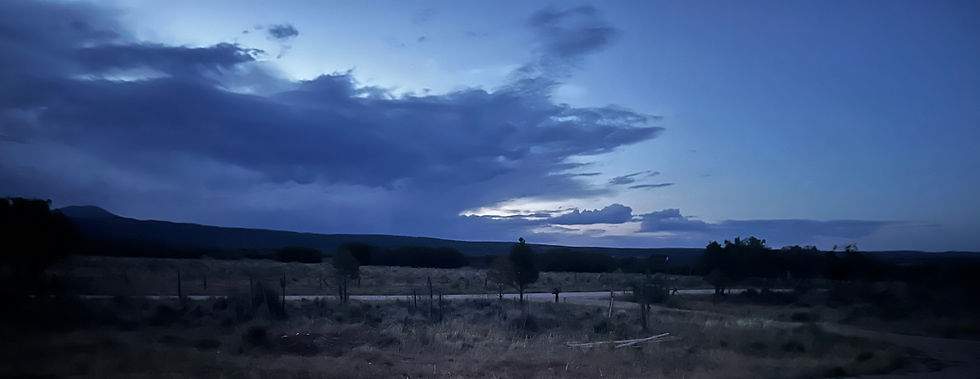
There are no streetlights to soften it.
No distant glow from a nearby town.
When the sun drops behind the rock, it leaves completely.
And in that absence, when the eyes adjust and the mind unclenches, something else becomes visible.
That’s where the light appears.
Not streaking like a meteor.
Not blinking like a plane.
Not drifting like a satellite.
It simply exists.
Low along the horizon.
Waiting to be noticed.
Caleb Mercer trusted what could be explained.
Twelve years working as a park ranger in canyonlands, near Moab Ut, had trained him to read the land. He could tell the difference between headlights and lanterns from miles away. He knew the altitude of aircraft by their sound. He had learned how heat, distance, and angle bend light into illusions.
There was always a reason.
It was a comforting way to live.
So when he first saw the light near Old La Sal up by Deer Creek, he dismissed it without effort.
He had parked just beyond a low ridge, engine off, sitting on the tailgate of his truck. The air held that high-desert chill that never quite bites, but never quite leaves. The last color had drained from the sky, leaving a deep blue that was already giving way to black.
He leaned back on his hands and looked up.
The first stars sharpened into view.
That’s when something in the corner of his eye broke the pattern.
A faint glow, low on the horizon.
He glanced at it once.
Probably a campsite. Maybe someone’s shining a flashlight farther out than usual. Could be headlights angling off a rock face.
He’d seen stranger things turn out to be simple.
But even as he looked away, his attention didn’t go with him.
Something about the light felt wrong.
So he looked again.
It wasn’t moving.
Not even a little.
It didn’t flicker like firelight.
Didn’t sweep like headlights.
Didn’t blink like an aircraft signal light.
It was just there—fixed, small, strangely patient.
Caleb sat up straighter.
Years of pattern recognition kicked in. Distance. Elevation. Possible roads. Known campsites. Flight paths.
None of it clicked.
He narrowed his eyes, watching.
Seconds passed.
Then, slowly—so slowly he almost doubted himself—the color warmed.
Pale white gave way to a softer, amber tone, like a lantern being turned up by an unseen hand.
The intensity deepened.
Not in a quick flare, but in a controlled, gradual rise.
Caleb felt a subtle tightening in his chest.
That small inner shift when your world stops matching your expectations, even slightly.
Not fear.
Awareness.
He stood.
Boots crunched on the gravel as he stepped a little closer to the ridge, trying to change the angle.
The desert around him remained still.
The light remained fixed.
He scanned the horizon again.
No roads in that direction.
No homes.
No campsites he knew of.
No aircraft.
He exhaled once, quietly, and did what years of training had taught him to do.
He decided to test it.
The truck engine turned over with a low growl that sounded louder than it should in that kind of silence. Caleb eased forward along the dirt road, headlights cutting a narrow path.
Road. Horizon. Mirrors.
Light.
The glow stayed exactly where it had been.
One minute.
Two.
Five.
The terrain shifted under his tires—small rises, shallow dips—but the light kept its position, calmly defying the idea that distance equals approach.
Same height.
Same apparent distance.
Same intensity.
As if the land beneath it had no effect.
He frowned.
Slowed.
Stopped.
Cut the engine again.
Silence fell back over him like a blanket.
And in that silence, the light responded.
It pulsed.
Once.
Slow.
Deliberate.
Not a flicker.
Not an accident.
A response.
Caleb froze next to the truck.
Every simple explanation he’d rehearsed over the years dissolved quietly. Not dramatically, but steadily, like water running out of a cupped hand.
Wind didn’t do that.
Campfires didn’t do that.
Reflections didn’t do that.
The light settled again, steady.
Then it began to change shape.
The edges softened.
The form stretched, losing its perfect roundness, becoming just asymmetrical enough to feel wrong.
Caleb felt the shift inside before he could name it.
Suddenly, he was no longer a man observing a thing.
He was a man standing in something.
A faint breeze moved down from the La Sals, cool and pine-scented, brushing against his face. It was oddly grounding in the middle of what made no sense.
He looked around, trying to find something—anything—to anchor his mind.
Just desert.
Just mountains.
Just that light.
Then his phone buzzed.
The sound was sharp in the quiet.
He almost jumped.
There shouldn’t have been service this far out.
He pulled the phone from his pocket.
The screen lit up, but not like it normally did. Thin lines of static crawled across the display, bending and warping what should have been clean icons.
No signal bars.
No notification.
No message.
Just interference.
He pressed the power button, turning it off.
Looked back up.
The horizon was empty.
The light was gone.
Not fading.
Not drifting away.
Gone.
Like someone had flipped a switch.
Caleb stayed where he was.
Minutes stretched.
Stars continued to ignite overhead, filling the sky in a slow crescendo.
His hands grew cold.
His breathing steadied.
The question did not.
He drove home later that night with his headlights cutting through a darkness that felt different now, like it had been rearranged.
He didn’t tell anyone yet.
Not because he was embarrassed or afraid of being laughed at.
Because he didn’t know how to explain something that hadn’t just been seen—but felt.
So he carried it, quietly.
For a while, the story lived only in his own memory, surfacing late at night when the desert felt close and the sky felt heavier than usual.
Eventually, though, he started testing the edges of his experience—dropping a careful question here and there, listening more closely when people talked about the land.
Until he realized he wasn’t the only one.
The first story he heard was older than his.
It belonged to a rancher who had lived near La Sal long enough to stop romanticizing the land.
“It’s beautiful,” the man said, “but it’s work.”
He’d seen weather roll in fast, seen animals spook hard at nothing he could identify, seen storms split and travel around the basin like it was being avoided.
He’d also seen the light.
Decades ago.
Back when Moab was quieter and Old La Sal was almost never mentioned by people who didn’t live there.
“It shows up when you’re not looking for it,” he said. “Always low. Always too steady.”
He described sitting on his porch one night after putting the horses up, staring across the dark basin, thinking about nothing in particular.
Then the light appeared.
He watched it for a long time.
He didn’t move toward it.
He didn’t run from it.
He just sat there, feeling oddly like something was taking stock of him.
“I never thought it was here to scare me,” he said. “I just never thought it cared whether I understood it.”
Another story came from a traveling couple.
They weren’t locals, and they didn’t think of themselves as people who “believed” in anything unusual. They were passing through, staying near Deer Creek for a night between national parks.
They described watching the sky, trying to catch an image of the Milky Way with a camera that wasn't the right equipment.
Then, right as they started packing up, their GPS glitched.
The screen froze.
The little arrow marking their position jumped off the road into blank space.
They turned around to see if they’d accidentally moved the GPS device.
That’s when they saw the light coming from above.
It hovered low, off to the side, distant yet somehow intimate.
They later said the strangest part wasn’t seeing it.
It was the feeling that they weren't the watchers, but the watched.
And just like with Caleb, it vanished the moment their phones came back to life.
Then there was the older man, who had lived in La Sal long enough that nobody had to tell him about the land—he had grown up inside it.
He never told a single story.
He just made a single statement.
“Whatever that is,” he said, squinting out toward the basin, “it isn’t passing through.”
He paused.
“It’s already here.”
And then, there was Emily.
Her story overlapped Caleb’s in uncomfortable ways.
She was a solo traveler, the kind who chose quiet in the crowd. She wasn’t chasing adrenaline or bucket-list to get photos. She was chasing space.
She came to Deer Creek for that reason alone.
On her second night, she stepped outside after midnight, wrapped in a blanket, and sat facing east, toward the Colorado boarder.
No agenda.
No camera.
Just stillness.
At first, it was the stars.
She tracked constellations she didn’t know the names of, noticed how many more appeared when there was no competing light.
Then her attention slid, almost on its own, to the horizon.
She didn’t see the light appear.
She realized at some point that it was already there, glowing on the horizon.
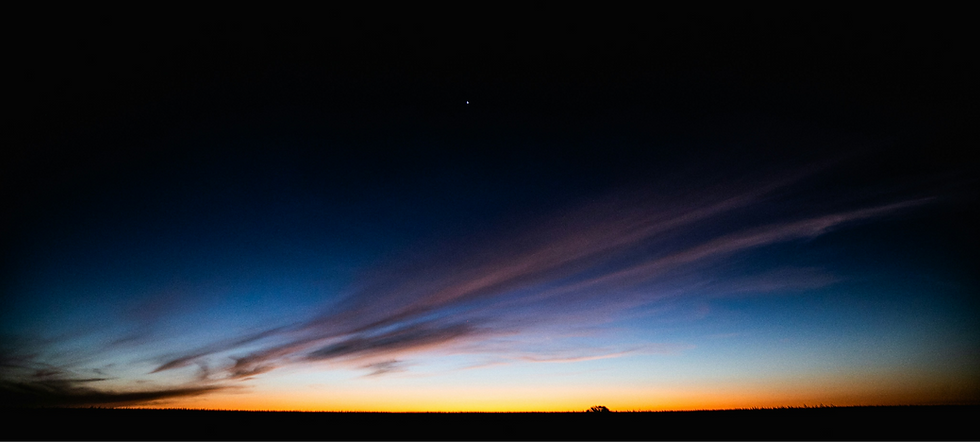
She thought, at first, that it was the sun rising.
Maybe she got the time wrong.
But it didn’t wasn't getting bigger or brighter.
The stars above remained.
Didn’t really touch the ground.
The light hovered just above the horizon line, then something small but deliberately present.
She stood without thinking.
Not in panic.
In curiosity.
“The weird thing,” she said later, “was that I felt like I’d stepped into something, not like something had stepped into my night.”
She took a few steps forward.
The light on the horizon brightened, more focused to a single point in the sky.
Not dramatically.
Gradually.
As if meeting her halfway.
That’s when sound disappeared.
Not reduced.
Not dampened.
Gone.
The little noises she’d stopped noticing—the brush of wind against fabric, the soft creak of the deck boards—dropped out.
She could still see herself move.
She wasn’t frozen.
But she felt like the world around her had been turned down to zero.
Inside that silence, the light condensed slightly.
She thought she saw something within it.
Not a face.
Not a structure.
Just the impression that it was not empty.
Then her phone, lying beside her, lit up.
The screen flashed once, then displayed a blank home screen, as if something had interrupted whatever it had been doing.
She glanced down.
And when she looked back up, the light was gone.
She stayed outside longer than she meant to.
Long enough for sound to return.
Long enough for doubt to try, and fail, to rewrite what had happened.
These stories don’t stack neatly.
They don’t resolve into a single, satisfying conclusion.
They overlap.
They echo.
They contradict each other in small details and agree with each other in something larger.
Presence.
Attention.
A feeling, more than a phenomenon.
And that’s why they linger.
Not because they prove something.
Because they suggest something.
Places like Deer Creek in Old La Sal Utah do that to people.
Silence removes distractions.
Distance removes the illusion of control.
The sky removes the assumption that we are the central story.
When enough of that is stripped away, people notice things they wouldn’t otherwise see.
Sometimes those things are ordinary.
A coyote call.
A change in wind.
The way their own fear rises and falls.
Sometimes those things are not.
Sometimes, in the vastness of the high desert, people come face to face with mystery.
Not in the sense of “solvable puzzle.”
In the sense of “something that enlarges you and unsettles you at the same time.”
Mystery is uncomfortable for the modern mind.
We are conditioned to resolve, to define, to capture.
But there’s a different kind of knowing that takes shape when you sit long enough under a sky like the one above Old La Sal, Utah.
You stop needing answers.
You start needing honesty.
You start needing to tell the truth about how small you are, and how much of reality sits outside your control.
Near Deer Creek, that truth feels especially close.
The land is wide.
The nights are deep.
The quiet is not empty—it is full.
Full of unanswered questions.
Full of old stories.
Full of the possibility that some things have been here longer than our words for them.
Longer than our ability to measure them.
If you find yourself out there, really out there, beyond the reach of streetlights and constant motion, you’ll almost certainly look up.
You should.
The stars above Old La Sal are worth the trip by themselves.
But if you stay a little longer than you planned…
If you let your eyes and soul adjust not only to the dark, but to the stillness…
If you let the silence roll all the way in and sit with it…
You may find your attention sliding.
Toward the horizon.
Toward that place where a few people, at different times, have seen a light that shouldn’t be there.
You may feel, even if only for a moment, that you’re being invited into something larger than you can name.
Not to understand it.
Just to witness it. Just to be.
A Final Challenge to You
If you’ve read this far into Moab Myths & Mysteries, the Old La Sal night sky has already started working on you. Don’t let the experience remain on a blog page. Come to Deer Creek Retreat and experience it firsthand—book the tiny home or the main cabin, turn off the lights, and let the mountain basin and infinite blanket of stars become the foreground of your own story. You don’t need to see a spacecraft, a UAP, or a little gray alien. You only need to be willing to lie beneath a darker-than-dark sky, acknowledge how small you are, and stare into the infinite long enough for it to change how you live and impact your soul.
Cheers,
Justin
About the Author
Justin holds a Ph.D. in Education and is an ordained professional chaplain, specializing in the integration of motivation and choice theory, psychological resilience, and pastoral soul care. He previously served ten years on active duty as a U.S. Army Chaplain in a critical care hospital, where he learned to sit with people in their deepest valleys and darkest nights.
He is the primary researcher and writer for grittygritgrit.com, a platform focused on perseverance, identity formation, and growth through adversity. Explore more reflections and resources at deercreeklasal.com.


Comments