
The Whispering Basin: Why Some Visitors Hear Their Name in the Dark

Updated: Aug 18
Why the quiet desert near Deer Creek's whispering basin leaves visitors with more than just a view
The Whispering Basin near Deer Creek is the kind of place where silence feels alive and visitors sometimes hear their own name in the dark.
By day, the land near Old La Sal looks like much of southeastern Utah: wide open, rugged, sun-washed, and honest about what it is. Red rock stretches into the distance. The La Sal Mountains rise with a kind of quiet authority. Sage, gravel, and shadow carve out a landscape that feels older than the routes that cross it. It is beautiful without trying to be, which may be part of why people remember it so clearly.
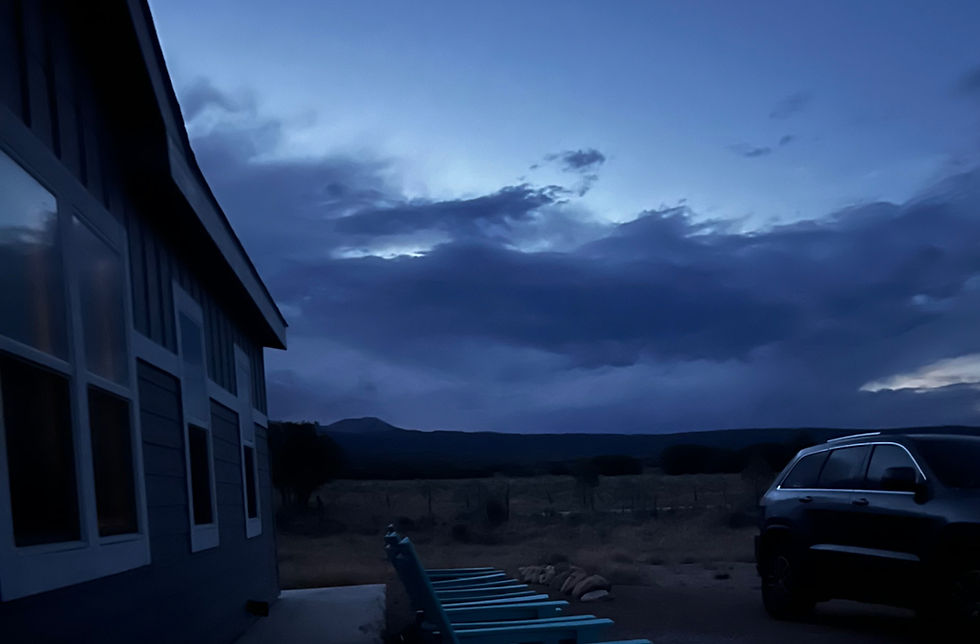
But when night settles over Deer Creek, the place changes.
Not in a dramatic, movie-like way. Not with flashing lights or sudden movement. The change is slower than that, and therefore harder to dismiss. The air cools. The horizon softens. The last traces of daylight slip behind the ridges, and the basin seems to gather the dark around itself like water filling a bowl. What remains is silence so deep it has texture.
That is where the stories begin.
Some people say the mystery is simple: the desert is quiet enough that the mind starts to reach for patterns. Others say that explanation is too tidy, too convenient, and too quick to explain away something that should not be brushed aside. A few insist the land itself holds memory, and that certain places seem to notice when a person stays still long enough to be noticed back.
No one agrees on exactly what is happening near Old La Sal.
But many agree on this: it is hard to spend a night here and not feel that the darkness is doing something more than simply covering the ground.
A place that trains your senses
The first thing the desert does is sharpen awareness.
People who live near or visit Moab often notice that the silence out here is not empty the way silence feels in a city room with the fan turned off. It has depth. It has distance. It has life in it, even when nothing appears to move. A breeze crossing the basin may sound faintly like speech. A coyote in the distance may seem closer than it is. A shifting branch, a screen door, or a change in temperature can all feel larger than they would anywhere else.
That is why so many people tell their stories with such conviction. The place itself makes them attentive.
When you sit outside near Deer Creek after dark, your senses begin to adjust. Your eyes work harder. Your hearing becomes more selective. Small changes in light and motion stand out. You notice your own breathing. You become aware of your body in space. And because the setting is so open, the mind has room to wander into the unknown.
That unknown is where the Old La Sal mystery lives.
The first story
One man, a former national park ranger who had spent years around canyon country, described his first encounter with "the light" as a moment that began with confidence and ended with uncertainty.
He had always trusted explanations. That was his habit, and in a place like the high desert, it had usually served him well. Misidentified aircraft, reflections, distant headlights, moonlight on rock—most strange things could be sorted out with enough patience. He knew that. He believed that. He had built his work life around it.
Then one evening, near Deer Creek, he saw a light on the horizon that would not behave like a light should.
It did not move toward him or away from him. It did not flicker or sweep. It did not reveal a road, a building, or a vehicle. It simply stayed where it was, small and steady, low in the dark. He watched it for a long time, trying to place it, trying to explain it, trying to convince himself it was ordinary.
Then it changed.
The brightness warmed from pale white to amber. The shape softened. It seemed less like an object and more like an event, something happening in place without needing permission from the land around it. When he turned the engine off, the light pulsed once, as if in response.
The experience did not terrorize him. That would have been easier to explain. Instead, it unsettled him in a quieter way. He realized he was no longer simply observing a thing. He felt observed by the thing.
That detail matters, because it appears again and again in other versions of the story.
Why people remember being watched
Most accounts of strange desert experiences include a common thread: the feeling that the land is not passive.
People don’t always say they saw something shocking. Often they say they felt something. A shift in the air. A pause in sound. A sudden impression that the night had become aware of them. The mind may later argue with that impression, but in the moment, the feeling is powerful enough to shape memory.
That is one reason the Old La Sal mystery lingers.
It does not rely on proof in the scientific sense. It relies on testimony, atmosphere, and repetition. One person hears a voice where no one stood. Another sees a light that doesn’t behave like a reflection. Another feels the silence deepen until it feels almost deliberate. Individually, each account could be questioned. Together, they build a pattern that refuses to fade.
The porch story
A guest staying at Deer Creek Retreat once described hearing his name spoken into the dark.
He had come expecting rest, not an experience. He was not hunting for paranormal stories and did not consider himself especially imaginative. He simply liked the idea of sitting outside under a night sky large enough to make city life feel small. On the second evening of his stay, he settled onto the porch after everyone else had gone inside.
The basin was still. The stars were sharp. The quiet seemed to press in gently from all sides.
Then he heard it.
His name.
Not loud. Not dramatic. Just enough to make him turn immediately toward the sound. Nothing was there.
He waited, listening. No footsteps. No voices from the house. No movement in the yard. Only the faint sound of the wind and the creak of something settling in the night air.
He laughed at first, because that is what many people do when they are caught between skepticism and surprise. But the laugh did not erase the moment. It only made it stranger. He said the experience felt less like hearing something external and more like being addressed by the place itself.
Whether that was imagination, stress, suggestion, or something else, he could not say. What he could say was that he never sat on the porch the same way the rest of his stay.
The couple who left early
A different story came from a couple who booked a quiet anniversary stay here at Deer Creek in Old La Sal. They wanted privacy, not mystery. They wanted stars, not legends. The first evening felt like exactly what they had hoped for.
They cooked dinner, watched the sky, and walked around the property before bed. The wife said the silence was almost restorative. The husband said it was intense enough that he became aware of every little noise, which is not unusual in a place without traffic, streetlights, or competing sound.
Later that night, the wife heard her name in the kitchen. She thought her husband had called to her, but he was already in bed. A few minutes later, he heard what sounded like a murmur outside the window. He checked the yard, then the perimeter, then the driveway. Nothing was there.
The strange part was not that they found nothing.
The strange part was that the nothing did not feel empty.
By morning, both of them admitted they had slept more deeply than they had in weeks. The stillness, the dark sky, and the mountain air had left them feeling restored, as though the place had given them a kind of rest they hadn’t realized they needed. It no longer felt like just a rental; it felt like somewhere with a story of its own.
Why silence becomes meaningful
That may be the heart of the Old La Sal mystery.
In most places, silence is a break between noises. Here, silence feels like a condition of the land itself.
There are no streetlights to soften the dark. No traffic to interrupt thought. No constant hum to keep the mind occupied. That means people begin to hear things they would normally ignore. More than that, they begin to feel things they would normally outrun with distraction.
This is where mystery becomes more than entertainment.
For some people, mystery is only a curiosity. For others, it is a reminder that the world is not fully mapped by their assumptions. In a place like Deer Creek, that reminder can feel almost spiritual. The basin invites the kind of stillness that makes people notice what they usually miss: their own thoughts, their own fear, their own longing for meaning.
And once a person begins to notice those things, the line between internal and external becomes harder to define.
The land as a mirror
One reason the Old La Sal mystery works so well in a travel series is that it reflects the traveler’s own experience.
People arrive looking for scenery, solitude, or a break from daily life. What they often find is not just a place, but an experience of themselves in a new key. The desert slows the mind down. It strips away noise. It makes the small feel small and the vast feel unavoidable.
That can be deeply restful.
It can also be disorienting.
The same silence that comforts one guest may unsettle another. The same sky that inspires gratitude may stir unease. The same horizon that offers peace may invite questions no one can answer neatly. That is why these stories keep returning. They are not only about the land. They are about the person standing in it.
And that is part of what makes the place linger in memory: it invites you to imagine yourself sitting outside after dark, listening for whatever the desert might reveal.
What the myth suggests
The myth does not need to prove a ghost, a spirit, or a UFO to matter.
What it suggests is more interesting: that some places hold enough silence, scale, and atmosphere to make ordinary people feel the edge of the unknown. That unknown might be psychological, spiritual, or supernatural. The story stays open on purpose. It invites the reader to lean in without forcing a conclusion.
That openness is part of the appeal.
When people come to Moab, they often want adventure. When they come to Old La Sal, they may get that same adventure, but something more as well: a brush with mystery that lingers long after the trip ends.
Come and listen for yourself
If you stay at Deer Creek Retreat, the experience is not scripted. No one can guarantee a strange light or a whispered name. But the setting itself is real, and the conditions that shape these stories are real: the wide basin, the deep night, the mountain air, the absence of city noise, and the sense that the desert is larger than your expectations.
That is enough to make a person pay attention.
And sometimes, attention is where the mystery begins.
If you come here, come with open eyes. Sit outside on the porch of the main cabin when the stars come out. Let the night settle around you at the tiny home's outside seating area. Listen long enough for the silence to become something you can feel.
That is when Old La Sal begins to speak.
Cheers
Justin
About the Author
Justin holds a Ph.D. in Education and is an ordained professional chaplain, specializing in the integration of motivation and choice theory, psychological resilience, and pastoral soul care. He previously served ten years on active duty as a U.S. Army Chaplain in a critical care hospital, where he learned to sit with people in their deepest valleys and darkest nights.
He is the primary researcher and writer for grittygritgrit.com, a platform focused on perseverance, identity formation, and growth through adversity. Explore more reflections and resources at deercreeklasal.com.


Comments