
Stories by the Campfire: La Sal Mountains Lake Night and the Dark Beyond the Fire
- Justin Shannon, Ph.D.
- Apr 5
- 8 min read
Updated: 7 days ago
The first time I camped by a La Sal mountain lake as an adult, I realized how different the dark feels when you’re the one in charge of the headlamp.
I’d camped plenty as a kid growing up in Moab. Back then, there was always my dad or the scoutmaster, some grown‑up whose silhouette looked steady in the firelight, the one who carried the extra batteries and pretended not to be scared of dinosaurs, Bigfoot, or some forest ghost. As long as we were cuddled by the fire, the shadows felt like part of the story.
“But it’s a different story when the boots by the fire are yours—and the kids watching the flames are looking to you the way you once watched your dad.”
What nobody tells you is that the dark doesn’t change much between twelve and fifty‑something. The trees are the same. The lake is the same. The only thing that really changes is who the night expects to keep it together.

That night, we’d hauled our gear up into the La Sals and tucked ourselves next to Mirror lake, near Old La Sal and Deer Creek Retreat, it looked like a dark mirror laid in the pines. The last light slid off the ridgeline, and the water grabbed the sky and pulled it down. The air changed from sun‑warmed dust to cold pine and granite. The kind of cold that makes your lungs sit up straighter.
The fire started small, the way all good campfires do, with stubborn bits of kindling and too much optimism. Sparks snapped up and disappeared into the blue‑black. The La Sal Mountains settled around us, the basin folding into shadow, and for a few minutes everything was simple: kids poking sticks into the flames, someone burning a marshmallow to charcoal, the smell of smoke threading into our clothes.
Lake, Dark, and Solitude in the La Sal Mountains Near Moab
Then the coyotes started.
It began as one long, rising note on the far side of the lake—a high, lonely sound that curled over the water and slipped into the trees behind us. Another voice answered from somewhere up the slope, sharp and excited, then another closer still. Within seconds it turned into a full chorus, yips and howls tumbling over one another like rocks down a wash.
The kids froze mid‑s’more.
“Are they close?” one of them whispered.
“Close enough to hear us talking about them,” I said, trying to sound steady. My joke landed thin in the night air.
Truth was, they sounded very close.
The fire suddenly felt small. The ring of light barely reached the edge of our boots. Beyond that, the forest was just layers of black on black, pine trunks rising like columns into a star‑soaked sky. The lake had turned to ink. Whatever was out there—coyote, deer, something else—could watch us without ever being seen.
The coyotes quieted as quickly as they’d started. The silence that rushed in behind them was worse.
You don’t realize how loud your life is until you’re somewhere that doesn’t care about your deadlines, your email, or whatever petty drama you left behind in town. Up there, at Mirror lake, my whole world shrank to the circle of firelight, the soft breathing of the kids in their camp chairs, and the thud of my own heart in my ears.
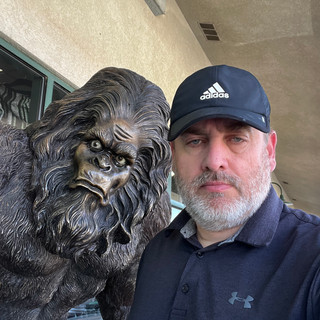
“Do you think there’s Bigfoot up here?” one of them asked finally.
There it was. The old question.

I thought of my scoutmaster back in Moab, his voice low and serious as he told us about Bigfoot sightings in the La Sal mountains, not far from here—he'd also speak of their existance and how somewhere in the thick timber of the Pacific Northwest, someone had filmed a tall, shaggy figure walking away from the camera like it had better places to be. I remembered the way he’d tap the side of his nose and say, “The thing about the mountains is, they’re big enough to keep secrets.”
As a kid, that line thrilled me. As a grown‑up, it hit different.
“Some people say they’ve seen him,” I told the kids, eyes on the dark tree line. “Some swear there’s something out there that doesn’t want to be found.”
“Do you think he’s real?” the oldest asked.
The old me—the one who liked neat answers and clean explanations—would have shut it down. Monsters aren’t real. Go to sleep. End of story. The part of me that had seen enough real‑world monsters, though, knew better than to pretend the world was that simple.
“I think,” I said slowly, “that the mountains are a good place to find out what you’re really afraid of. Whether that’s Bigfoot, or the dark, or just being alone with your own thoughts.”
They went quiet at that. The fire popped. Somewhere far off, a coyote gave one last half‑hearted yip, like a heckler who’d lost his nerve. Then a hoot from an owl, off in another direction.
We roasted the last marshmallows and let the conversation drift. Stories turned silly. Laughter came back. Eventually, the kids peeled off to their tents, one by one, headlamps bobbing across the shadows like tiny comets. Zippers rasped shut. The camp settled.
That’s when the real night showed up.
The wind slipped down off the ridge, cold and sure, and slid under my jacket. The fire burned down to a bed of coals, low and mean, the heat hugging the ground. Without the chatter of voices, every sound jumped out: the tiny clinking of cooling rocks, the soft lap of water on the shore, the creak of a nearby branch shifting under its own weight.
I was alone by the fire.
My own mind turned on me first.
What if something’s standing just out of sight? What if the kids wake up and can’t find you? What if you’re not as brave as you’ve been pretending to be?
Coyotes I could handle. Bigfoot I could rationalize. It was this—this feeling of being small and exposed under a sky that didn’t need me—that pressed in on my chest.
I tossed another log on the coals and watched the flames crawl up its side. The light pushed back the dark a few feet more. Not much, but enough. I took a slow breath and felt the tightness in my shoulders.
Somewhere between the crackle of the fire and the soft slap of water, another thought came, quieter than the fear:
You wanted this.
You didn’t drive up into the La Sal Mountains to camp at Mirror lake because you love comfort. You came because the world down there is too loud and too bright and too easy to control. You came because you needed to remember what it feels like when you’re not the biggest thing in the room.
The coyotes howled again, farther off now, their voices rolling together like some wild kind of choir. Instead of flinching, I let the sound wash over me. They weren’t coming for us. They were just doing what they were made to do—calling to each other across the dark, reminding the basin that they were there.
I realized I was doing the same thing.

Sitting by a small fire under a ridiculous amount of stars, heart beating too fast, trying to remember who I was when the Wi‑Fi drops, there are no cell bars, and the only notifications are from the wind and the animals. The fear I felt wasn’t about predators. It was about being seen. Not by Bigfoot or coyotes, but by the mountains themselves—by a place that had watched people come and go long before me and would keep watching long after.
And in that strange way the La Sals have, the fear shifted.
It didn’t disappear. My heart didn’t suddenly slow to a meditative hum. But underneath the jittery edge, something sturdier took root. A sense that maybe the point of being out here wasn’t to prove I was fearless, but to finally admit that I wasn’t—and to stay anyway.
That was the redemptive turn the night seemed to offer: courage wasn’t the absence of the tremor in my hands as I fed the fire; it was choosing not to douse the flames, not to hustle everyone back to the car, not to pretend the dark didn’t make me feel ten years old again.
I sat there a little longer, listening.
A fish broke the surface of the lake with a soft plop. The breeze shifted and brought the smell of wet earth and sap. The stars over the La Sal peaks burned cold and clear, reflected twice—once in the sky, once in the black water. Behind me, a kid coughed in their sleep, the sound small and painfully human.
I smiled into the shadows.
“Okay,” I said quietly, to no one in particular. “You win. You’re big. I get it.”
The mountains didn’t answer, not with words. They answered with more silence. More stars. Another coyote calling out in the distance, that owl makes a few hoots in the night air, not threatening, just there.
Sitting at that lake, I realized that what had driven me up into the La Sals in the first place—the same thing that brings guests to our cabin and to these campfires—wasn’t just the view or the cooler temperatures. It was the chance to be recalibrated by a place that doesn’t care what you post on social media, what kind of money you make, or how important you are on the other side of the pass.
Up here, you’re just a person by a fire, listening for coyotes. Enjoying the night air filled with mystery and the ocassional hoot from that owl. And somehow, that’s enough.
Eventually, I kicked dirt over the coals until they glowed dull red and then blackened out. The dark rushed back in, but it felt less like an enemy now and more like a heavy blanket pulled up over the basin. I walked the narrow trail back toward the tents, headlamp beam shaking just a little as it caught roots and rocks and low branches.
Halfway there, I paused and flicked the light off.
The lake was only a hint of silver now. The trees were cut‑out shapes against the sky. The stars were so thick it felt like you could lean back and feel them on your skin.
“Are you scared?” I asked myself, honestly.
“Yes,” something in me said.
“And?”
“And I’m still walking.”
“Are you scared?” I asked myself, honestly.
“Yes,” something in me said.
“And?”
“And I’m still walking.”
That was enough redemption for one night.
Mirror Lake, La Sal Mountains: A Quiet Place to Stay Near Moab
If you want your own La Sal lake night
Mirror Lake sits up in the La Sal Mountains, about 8.6 miles from Deer Creek Retreat. The road is unimproved and you do have to drive a high‑clearance, two‑ or four-wheel‑drive vehicle straight through the creek—no bridge, no guardrails, just you, the water, and the mountain watching. On up the dirt road, through the quakies, the mountain air up to the Mirror lake turn off or straight ahead to the Mount Peale trail head.
If the idea of crossing a cold creek in your own rig and camping by a dark, quiet lake makes your pulse jump a little, that’s kind of the point. When you stay at Deer Creek Retreat, in the main cabin or the tiny home, nights like that are close enough to touch. The mountains will take care of the rest.
Come on out for a stay!
Justin


Comments