
Stories by the Campfire: Snowstorm in the La Sal Mountains

Updated: Jun 17
The first time a winter snowstorm La Sal Mountains peaks sent our way rolled over Deer Creek Retreat, I learned how loud silence can get when the wind finally stops.

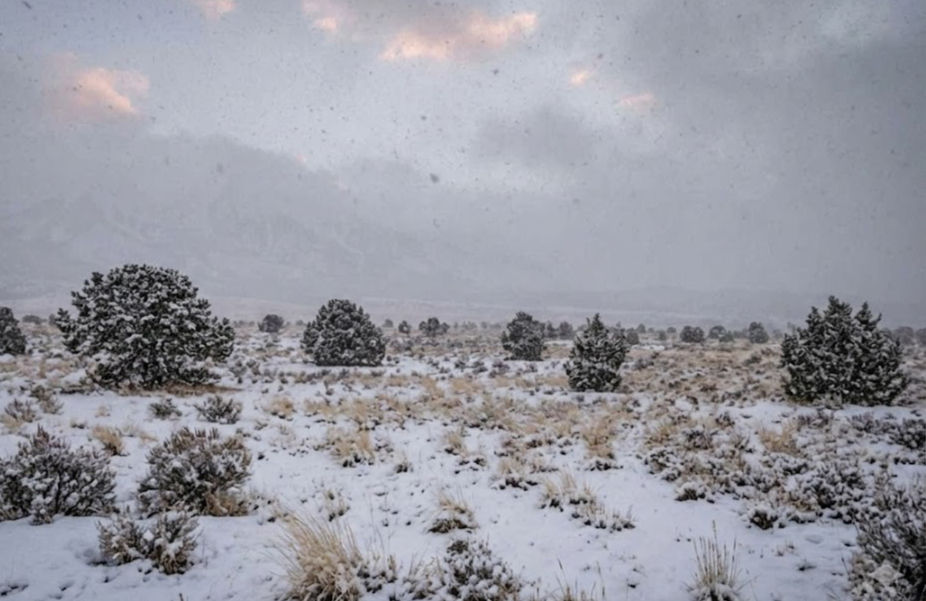
It started as a normal winter day in the La Sals. The Old La Sal valley wore its usual patchwork of snow and sage: drifts tucked into the shade, bare spots where the wind had scraped everything down to frozen dirt, the sky a color of steel. The forecast had muttered something about snow and gusts, but out here, you learn forecasts are suggestions, not promises.
By late afternoon, the wind picked up. Not a gentle breeze, not even the kind of pushy gust that makes you zip your jacket. This was the kind of wind that leaned on the cabin walls like it had an opinion about how you arranged your life. The coat, thick pants, well they don't stop the cold and wind coming through.
Inside, the kids were scattered between the couch and fire place, the bunk beds, and the floor, building forts out of blankets and arguing over who got which flashlight. My wife watched the sky through the window above the kitchen sink, the way people do when they’ve seen weather turn fast before and don’t quite trust what they see.
“You think it’ll really hit?” she asked.
I checked the windows, then outside to see if there were any deer, then the way the trees bent just a little more with each gust.
“It’s the La Sals,” I said. “If it doesn’t hit, it’ll just be saving up for next time.”
Outside, the first snowflakes started sideways.
Snowstorm in the La Sal Mountains
There’s a certain point in a storm when it stops being background and becomes the main character. You know it when it happens. Conversations trail off. People move closer to the windows without meaning to. Noise outside starts to organize itself into something you can’t ignore.
That moment came when the wind shifted and slammed straight into the side of the cabin.
The walls answered with a low, steady creak. Not a panic sound. More a reminder: you’re in the mountains, in a small structure, and the elements don’t care how many emails you answered this week.

The kids went quiet.
One of them looked up from a book. Another paused a game mid-complaint. The littlest climbed up onto the couch and pressed in against my side without saying anything. My wife dried her hands on a towel and sat down in the chair across from us, facing the window as if it were a screen.
As the snowstorm La Sal Mountain peaks often thickens, the basin turned into a whirl of white. The scattered trees blurred, and the fence line lost definition. The scattered trees blurred, and the fence line lost definition. We could still make out the shapes of the La Sals looming above us, but they looked different—closer and farther away at the same time.
I felt the familiar weight of the Glock on my hip, utterly useless against snow and wind. There’s something humbling about that. Out here, the storm doesn’t care who’s armed or who’s in charge. It just does what it does, and you sit with it.
“Are we okay?” one of the kids asked.
“Yeah,” I said. “We’re okay. Cabins like this are built for bad weather. We’ll ride it out.”
I believed it. Mostly.
Inside the Storm’s Heartbeat
As the evening settled, the storm found its rhythm.
Wind roared, then dropped, then roared again. Snow slapped the windows and hissed off the roof. Every so often, there’d be a sound that didn’t quite fit: a thud, a scrape, something shifting or falling outside. Each one tightened the room a little.
We did the things people do when the world shrinks to the size of four walls.
We made hot chocolate, the real kind, with too much powder and too few mugs that weren’t already claimed. We told the kids to pick one flashlight each “just in case,” then pretended we weren’t also checking where the candles were and how many matches we had. We double-checked the charged battery lantern and laughed at ourselves for being dramatic.
But underneath the jokes, the storm kept talking.
At one point, the lights flickered—just enough to hush everyone mid-sentence. They stayed on, but the possibility was out there now. The kids looked at me, and I looked at the ceiling as if that would help.
“If the power goes out,” I said, “we’ve got blankets, flashlights, and each other. We’ll be fine. Might even make for a better story.”
“You mean like one of your campfire stories?” the oldest asked.
“Exactly,” I said. “Except in this one, we know where the marshmallows are.”
That got a small laugh. The tension rose and fell with the wind.
Outside, the plain of the valley disappeared.
There’s a strange comfort in not being able to see past your own window. You’re forced to shrink your kingdom again: this couch, this room, these people. The storm becomes a kind of curtain drawn over the rest of your life. Your to-do list is on the other side of it. So is your email, your mobile, your worries about work, and your questions about the future. For a few hours, the only question that matters is, “Are we together, and are we warm?” That is the true heart of experiencing a major snowstorm La Sal Mountains style.
Wrestling more than weather
Storms like this always wake something up in me. As the wind battered the walls, I couldn’t help thinking about how many of the hardest battles we fight have nothing to do with weather—storms that live in our chests, or minds, or in the quiet spaces between people who love each other. Scripture talks about wrestling not just against flesh and blood but against darker, unseen things, and nights like this in the La Sals make that feel less like poetry and more like a diagnosis.
Because what are you really wrestling with when the snow blocks the road, and the wind reminds you you’re not in control?
Part of it is fear, sure. Not movie fear, but that low, quiet kind: What if this gets worse? What if we lose power? What if something goes wrong and nobody can get here fast?
Part of it is pride—the illusion that you run your life, that you’re the main force moving your story forward. A good storm strips that away. The mountains let you know you’re not the biggest thing in the room.
And part of it is something holier: the sense that Someone might actually be using nights like this to get your attention. To ask: “When everything else is peeled back—noise, busyness, distractions—who are you really? Who are you when it’s just wind, wood, and the people you love in a small space?”
I didn’t share my concerns out loud. I just sat with my family, listening to the storm, feeling the questions in my chest.
The eye inside the cabin
At some point, the kids settled.
A game of cards started on the floor, spread out on a blanket like a picnic. Somebody dug out a notebook and started drawing the storm as best they could: swirls, heavy lines, a little square cabin in a sea of scribbles. My wife read a book by the window, the kind you can dip in and out of between checking the sky.
The cabin itself became a sort of eye in the storm—a still center where the noise outside only made the quiet inside feel richer.
I noticed small things.
The way the heater kicked on a little more often. The mug warmed my hands when I wrapped them around it. The way the kids’ voices went soft as they got tired, dropping from arguing volume to bedtime volume without anyone telling them to.
For a few minutes, the whole room fell silent.
No one was asleep yet. No one was on a screen. We were just…together. Present. Listening to a storm beat on the walls and discovering that the fear we felt at first had been replaced by something else: a strange mix of peace and awe.
“Kind of cozy,” my wife said quietly.
“Yeah,” I said. “Kind of holy, too.”
When the quiet finally arrives
Sometime after midnight, the storm started to spend itself.
The wind lost its sharp edges. The snow turned from sideways to straight down. The cabin’s creaks softened, like it was exhaling along with the rest of us.
I stepped outside onto the porch, just for a minute, to meet what was left of it.
The air hit me like a wall—cold and clean, with that metallic bite you only get when the thermometer sinks low, and the world is wrapped in white. My breath puffed out in front of me, visible proof that I was still here, still warm inside, still breathing.
The Old La Sal valley plain looked new.
Snow had smoothed the rough places, softened the brush, erased the old tracks. In the moonlight, the La Sals glowed faintly, their ridges outlined against a sky that suddenly seemed impossibly clear. The storm had done its work and moved on. What remained was silence—not empty, but full.

I thought of all the storms I couldn’t see: the ones in my kids’ growing hearts, in my own restless mind, in the wide, wider world beyond this valley. I thought of the God who rides on the wind but also whispers in the still small voice that comes after.
For a moment, I felt very small and very held at the same time.
A Softer Landing Back Inside
When I went back in, the cabin felt different.
Same walls, same furniture, same pile of boots by the door—but the air in the room felt like it had thickened with something good. The kids were asleep in a tangle of blankets, cheeks flushed from heat and adventure. My wife had dozed off with a book open on her chest.
The storm had shaken everything just enough to remind us what mattered.
I turned off the last light, listened to the heater hum, and lay down knowing that in the morning, we’d wake up to a remade valley plain—snow deep along the fence line, animal tracks tattooing the white, the mountains bright and sharp in the clean air.
If you’re staying at Deer Creek Retreat when a storm like that rolls in, my advice is simple: don’t rush past it. Let it inconvenience you. Let it shrink your world to the size of this cabin and these people for a night. Sit with the wind, the creaks, and the questions. Then, when the snow finally settles, and the quiet comes, step out on the porch and see what the La Sals have to say when the rest of your life is on the other side of the white.
Come and stay with us, the main cabin or tiny home, make the next storm apart of your family memories!
Cheers!
Justin
About the Author
The author holds a Ph.D. and is an ordained professional chaplain, specializing in the integration of motivation and choice theory, psychological resilience, and pastoral soul care. Transitioning from a ten-year active duty career as a Captain in the U.S. Army—where he served within the high-intensity environment of a critical care hospital—his work bridges empirical behavioral science with practical strategies for long-term identity formation. He serves as the primary researcher for grittygritgrit.com, a digital platform dedicated to helping individuals cultivate authentic perseverance through the profound transitions, traumas, and valleys of life. You can explore more of his work and high-mountain-desert writing at deercreeklasal.com.


Comments