
Unplug Near Moab: How the High Desert Breaks the Grid

Updated: Aug 18
Unplug near Moab—it sounds like a simple vacation goal, but the moment you leave the paved highways and turn toward the high desert basin of Old La Sal, you realize disconnection isn't just something you choose; it’s something the land invites.
In our hyper-connected world, we carry an invisible shield wherever we travel. We move through our days with satellite networks overhead, GPS blue dots pinpointing our exact position within inches, and the quiet comfort that help, answers, directions, or digital distractions are always a tap away. We have mapped the world so thoroughly that the concept of getting lost or stepping out of reach feels almost foreign.
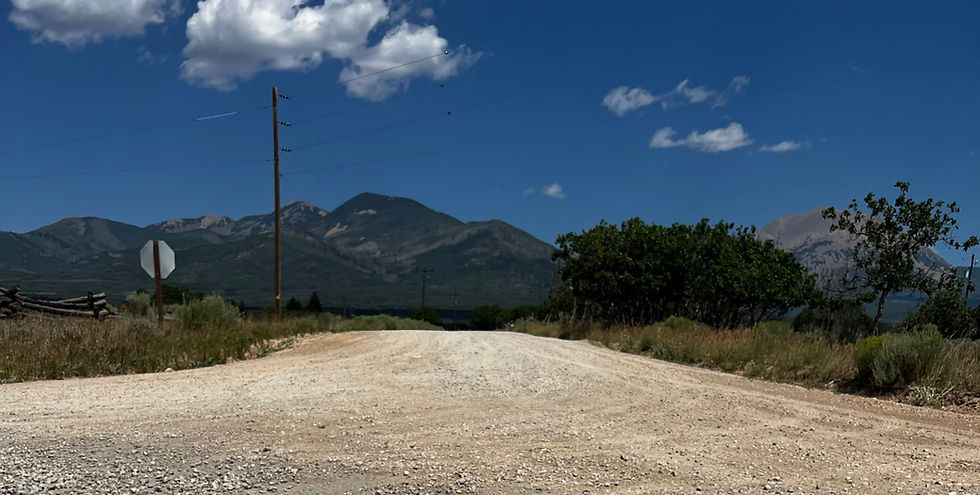
Then you drive out of town, head up toward the La Sal Mountains, and approach Deer Creek.
And the grid begins to fray.
It rarely happens all at once. First, your signal drops from LTE to a single fragile bar, and then to No Service. But out here, the phenomenon goes far deeper than a missing cell tower. Ask almost anyone who has spent extended time exploring the red rock country and mountain passes surrounding the Moab area, and they will tell you about moments when modern devices didn't just stop working—they acted strangely.
If you are looking for a true place to unplug near Moab, understanding how this high-desert environment alters our relationship with technology is where the real journey begins.
The Canyon Glitch: Why Technology Fails When You Try to Unplug Near Moab
It is a common story among hikers, trail runners, landscape photographers, and back-road drivers navigating the canyon networks near the La Sal basin.
You are tracking a familiar trail or dirt route on a digital handheld GPS. The sky above is a cloudless, brilliant cobalt blue, with no physical obstruction in sight. Suddenly, the screen freezes. The digital cursor jumps half a mile across the map into a solid sandstone cliff face or begins spinning in slow, erratic circles.
Photographers setting up tripods in the basin late at night report full camera batteries draining to zero in a matter of minutes, only to show a full 100% charge again once they return to town. Smartwatches vibrate with phantom notifications far outside network range. Time-lapse cameras capture subtle light refractions low on the horizon that do not appear in surrounding frames.
Geologists and radio engineers offer grounded, logical explanations for these events:
Iron-Rich Wingate Sandstone: High concentrations of iron oxide in the surrounding red rock cliffs create localized electromagnetic pockets that interfere with delicate digital compasses and magnetometer sensors.
Parabolic Canyon Acoustics & Signal Bounce: Sheer, smooth sandstone walls act as giant natural reflectors, bouncing satellite and radio signals back and forth until digital receivers lose calibration.
High-Altitude Thermal Drops: Desert air at 6,000+ feet cools rapidly after dusk. Rapid temperature drops slow down the chemical reactions inside lithium-ion batteries, causing them to temporarily register as fully depleted.
These scientific explanations are rational. They make complete sense on paper.
Yet when your phone screen flickers with subtle static lines while you sit on a cabin porch under an impossibly deep sky, the technical explanations feel secondary to the immediate, visceral reality: You have stepped completely outside the grid.
The Mystery That Kept Its Secret in the Wilderness
Nothing illustrated the desert’s ability to resist modern surveillance and human control quite like the story of the Utah Monolith in late November 2020.
A team of state wildlife biologists flying in a helicopter south of town through Lockhart Basin spotted a glint of polished metal deep inside an unnamed red-rock canyon. When they landed to investigate, they found a 10-foot-tall, three-sided stainless-steel prism anchored seamlessly into the solid sandstone floor.

There were no tire tracks nearby. No visible footprints. No obvious signs of heavy machinery required to cut into bedrock and mount a massive steel structure in deep wilderness. Satellite imagery analyzed by internet sleuths later revealed that the structure had been standing quietly in that remote pocket of rock since mid-2016—standing unnoticed for over four years before a human eye caught sight of it.
In an era where every square foot of the planet is imaged by commercial satellites, geotagged on social media, and rated on travel apps, a massive steel monolith stood in the open Utah desert for four years without the internet knowing it existed.
When public authorities kept the location secret to avoid environmental damage, online communities used flight paths, shadow angles, and rock formations on Google Earth to pinpoint the exact coordinates within 24 hours. Yet just as crowds began to flock to the remote canyon, a group of local outdoor enthusiasts extracted the monolith late one night to protect the fragile desert soil from heavy foot traffic, leaving behind only a small metallic triangle in the rock.
The monolith captured global fascination not just because it was unusual, but because it reminded us of a truth we constantly forget: The high desert keeps its own secrets. It refuses to be fully mapped, managed, or mastered.
The Psychology of Digital Noise vs. High-Desert Silence
We live in an age of continuous cognitive input.
Psychologists refer to our modern condition as "continuous partial attention." We are constantly monitoring feeds, checking messages, reviewing calendars, and anticipating notifications. This state of perpetual hyper-vigilance keeps our autonomic nervous system slightly elevated—a low-grade, persistent stress response that we rarely notice until it finally stops.
When you enter the quiet expanse of Old La Sal, your brain undergoes a process known in environmental psychology as Attention Restoration Theory (ART):
Directed Attention Fatigue: Modern life demands hard, focused attention on screens and tasks, which rapidly depletes our mental energy.
Soft Fascination: Natural environments—like watching light shift across the La Sal Mountains or staring into a dark sky filled with stars—engage our minds effortlessly.
Nervous System Downshifting: Without artificial dings and screens demanding immediate response, the body transitions out of fight-or-flight mode and into deep recovery.
The silence of the high desert is not an empty vacuum; it is an active environment. It gives your mind permission to process accumulated thoughts, reset attention spans, and restore internal clarity.
Reframing Disconnection: A Gift, Not a Glitch
We are conditioned by modern society to treat technology failure as an annoyance—a temporary glitch that demands an immediate fix.
When a screen freezes or a signal drops, our instant reaction is mild friction. We raise our phones higher into the air. We search desperately for Wi-Fi. We fight the disruption because we have come to mistake constant connectivity for safety and control.
In my work specializing in human motivation, psychological resilience, and pastoral soul care, I have observed how relentless connectivity quietly drains the human spirit. When we are constantly plugged in, our attention is perpetually pulled outward. We manage inputs, respond to incoming alerts, and absorb endless background noise. We rarely leave room for our own unedited thoughts—let alone the quiet processing of grief, longing, deep rest, or personal reflection.
That is precisely why the technological boundary surrounding Old La Sal isn't a flaw. It is a feature.
When you choose to unplug near Moab at Deer Creek Retreat, the digital noise drops away, and the physical world fills the void instantly. Without a screen pulling your eyes downward, your physical posture changes. You look up. You notice the deep violet hue that settles over the La Sal Mountains right after sunset. You hear the crisp mountain breeze moving through the sagebrush. You notice how quiet your own mind becomes when it stops anticipating the next notification.
How to Truly Unplug During Your Stay at Deer Creek
If you’re planning a trip to Old La Sal, disconnecting doesn't happen automatically—it takes a small, intentional shift in routine. While Deer Creek Retreat offers Wi-Fi to keep you grounded, there is no cell service out here. Rather than seeing that as an inconvenience, here is how to turn the digital quiet into the best part of your stay:
1. Download Offline Maps Before Leaving Town
While cell service works well along main highways, signal drops quickly as you drive past New La Sal and ascend into the ridge and back down into Old La Sal basin. Download offline trail maps (via AllTrails or Google Maps) while you are in downtown Moab so you can navigate backroads without needing active cell towers.
2. Embrace the "Analog Evening" Routine
When you arrive at the Main Cabin or Tiny Home, set your phone on airplane mode or place it inside a drawer. Spend your first evening on the porch with a warm drink, letting your eyes slowly adapt to the twilight as the mountains change color.
3. Stargaze Without the Screen
It takes roughly 20 to 30 minutes for human eyes to fully adapt to true dark skies. Checking a bright phone screen resets that adaptation instantly. Leave your phone indoors when you step out to view the Milky Way, allowing your vision to capture the full depth of the night sky.
4. Give Yourself Permission to "Do Nothing"
In a culture that measures every vacation by activity output, give yourself permission to sit still. Read a physical book, listen to the wind across the basin, or simply watch the morning light illuminate the peaks without needing to broadcast the moment to a social feed.
The Practice of Stillness: What High Desert Dark Teaches
We spend the vast majority of our lives in environments engineered for predictability.
Our cities are lit by automated streetlamps that turn on dusk after dusk. Our homes are climate-controlled to a single degree. Our workdays are partitioned into calendar blocks, push notifications, and predictable routines designed to keep uncertainty far at bay. We have constructed a world that systematically minimizes the unknown.
And yet, millions of people travel to the canyonlands of Utah every single year. They hike steep trails, drive dusty backroads, and seek out places where the rock is raw and the landscape feels entirely indifferent to human schedules.
They often say they are coming for the views, the red rock arches, or the high-adrenaline outdoor recreation. But if you talk to them late in the evening after the gear is packed away, you discover something far deeper: They came looking for space.
Real perspective rarely arrives in the middle of noise. When life becomes loud, our mental focus naturally narrows to immediate survival and task management. We react instead of reflect. We manage symptoms instead of asking deeper questions about where we are going and why.
To regain perspective, the human spirit requires contrast. It needs environments that are vastly larger than our immediate problems—places where the sheer scale of the landscape gently forces our self-importance to shrink back down to size.
That is the true gift of the Old La Sal basin. When you sit outside at night in Deer Creek, you aren't just sitting in the dark; you are sitting inside an unbroken canopy of stars that stretches from horizon to horizon. The elevation is high, the air is thin and clear, and the light pollution of modern civilization is miles away behind sandstone ridges.
The dark out here isn't oppressive—it is spacious. It creates the mental room required for the mind to unclench.
Bringing the Journey Home: The Old La Sal Chronicles
Throughout this four-part series, we have walked together through the distinct, captivating layers of Old La Sal:
The Light Over Deer Creek: Exploring the atmospheric mystery of dark skies and the patient, unexplained horizon light.
The Whispering Basin: Experiencing the deep spatial acoustics of the desert, where silence feels so alive that visitors hear their own names carried on the night wind.
Turning Quiet Into Connection: A personal reflection on memory, my late brother Todd, and how the La Sal Mountains hold space for grief, healing, and genuine presence.
The Grid Drops Here: Learning how tech anomalies and digital silence invite us to embrace the discipline of unplugging.
These stories do not ask you to become a paranormal investigator, a hermit, or an outdoor survivalist. They simply offer a gentle invitation to surrender the illusion that you must control every aspect of your environment to be at peace.
Sitting on the porch of the main cabin or outside the tiny home at Deer Creek, watching the shadows lengthen across the basin, you learn that smallness isn't something to fear. It is the very beginning of perspective.
You realize you don't need to capture every sunset in a photo, tag every trail on an app, or explain every light on the horizon. You only need to sit quietly enough to let the stillness remind you of who you are when all the artificial noise is finally turned off.
Your Invitation to Step Outside the Noise
The Old La Sal basin isn't a theme park ride, and its stories aren't scripted scripts for tourists passing through. They are an invitation to step out of the rush, pull off the busy highway, and meet a landscape that has been waiting quietly long before we arrived.
Whether you need space to think, a quiet sanctuary to honor a memory, or simply a night under a sky so dark the stars feel close enough to reach out and touch—Deer Creek Retreat is here.
Turn off the car engine.
Step onto the porch.
Put your phone in your pocket.
And let the high desert speak for itself.
Complete Your High Desert Retreat!
Are you ready to unplug near Moab and experience the dark skies, mountain views, and deep stillness of Old La Sal for yourself? Reserve your stay at the Main Cabin or the Tiny Home today!
Cheers,
Justin
About the Author
Justin holds a Ph.D. in Education and is an ordained professional chaplain, specializing in the integration of motivation and choice theory, psychological resilience, and pastoral soul care. He previously served ten years on active duty as a U.S. Army Chaplain in a critical care hospital, where he learned to sit with people in their deepest valleys and darkest nights.
He is the primary researcher and writer for grittygritgrit.com, a platform focused on perseverance, identity formation, and growth through adversity. Explore more reflections and resources at deercreeklasal.com.


Comments