
Epilogue: Staring Into the Infinite | Night at Deer Creek Retreat

Updated: Sep 4
Staying Small Under the Old La Sal Night Sky
Closing the Series on a Deer Creek Retreat Night
By the time this trip to Deer Creek becomes an epilogue, the Old La Sal basin and the sky above it have taken over, and the story is about more than meets the eye.
In the past, the space crafts, pulses of light, and shadowy figures off in the trees were merely details. Back in the basin, the property, the ridge, and the way people stood in, around, and beneath them—that was the real plot.
He knew this now.
He was back at Deer Creek Retreat, but this time he wasn’t the main character. Not really. He was somewhere between host and witness, moving quietly through the tiny home and main cabin during the day, making sure they were ready for whoever might come to stare into the infinite next—and then stepping away to let them have the place to themselves.
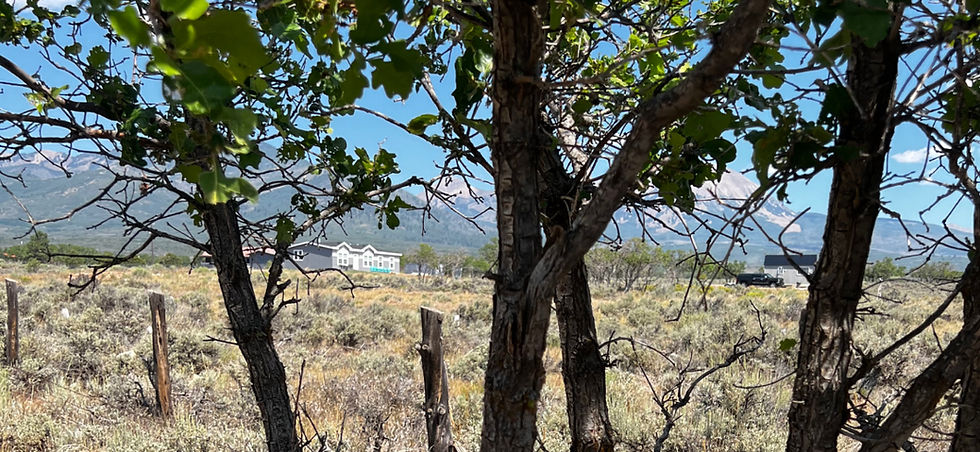
The day was ordinary. Not ordinary in the sense of routine, but in that all was normal. Same beautiful mountain views, glorious blue sky stretching from one ridge to the next. The same clean, crisp air. The silence that is golden.
The day was ordinary, and that mattered.
Grass along the fence line needed trimming. Tools had to be put away. Sheets in the loft at the tiny home were freshened, skylights checked, tiny kitchen stocked with what he could offer. At the main cabin, counters were wiped, the bay window dusted so the mountains could shine through, porch swept clean of the fine mountain grit that settled everywhere.
No one paid him to create stories of anomalies. His take on local UFO sighings was a side point.
He was just making sure strangers had a place to sleep.
By late afternoon, he locked up the shed, checked the last details, and headed back toward town, leaving the property quiet and ready. He knew from years of messages and reviews roughly what would unfold, even if he was not there to see it.
A young couple would check in to the tiny home—people who booked specifically for stargazing, cameras ready, eyes bright with the hope of seeing the Milky Way for the first time without city light.
An older solo traveler might take the main cabin—a retired teacher or writer, tired from the drive, carrying a notebook and a battered Bible in the same bag.
He would be in their story only as a name in the welcome message.
The property would do the rest.
Later, as he sat in his own place miles away, he pictured the sun setting behind the western ridge, revealing the La Sal Mountains with a golden shimmer, as if framed for a picture above a mantel.
Shadows would stretch across the basin, then merge, then finally become the unbroken field of night.
At the tiny home, he imagined the couple turning off interior lights and climbing the ladder to the loft, lying side by side under three skylights that turned the ceiling into a window. From there, the Old La Sal night sky would unfold above them like a living map.
At the main cabin, he pictured the retired teacher in a simple chair on the front porch, watching as individual stars pricked through the deepening blue, then multiplied until the sky was nearly crowded with light.
If a camera captured the scene from above, it would show these human stories on five acres of land, each framed by the same basin and dome of infinite stars.
He didn’t need to know those stories in detail.
He only needed to let them happen.
The first band of the Milky Way would appear over Deer Creek, making way for the night sky.
He smiled, thinking of guests who had written later to say, “It’s thicker and more brilliant than I thought—like someone spilled sparkling dots of light over a black canvas and the spill never dried.”
Others had told him that, sitting in that bay‑window chair, they felt as if the sky were pressing slowly into their living room.
The Old La Sal night sky took center stage.
He had learned to fade to the wings.
Hours would pass.
The mountain side would quiet in stages.
Distant neighbors would dim their porch lights.
The small road that runs past the property would hold little or no traffic.
Insects would provide a faint, steady thread of sound, then even those would dull until the silence was nearly complete.
From his own porch in another town, he would remember how the property felt at that hour from previous stays—familiar and yet different each night.
The disk, the triangle, the Gray, the light trails—none of those were promised.
No beams had to hover at doorways.
No pulses had to ride his ears.
The Old La Sal night sky did not need to perform.
It simply existed in full density, stars packed into the darkness like seeds in rich soil.
He realized, the more he thought about it, that this was the real baseline of the series.
The anomalies had been spikes—exceptions, intensifications.
The infinite was enough on its own.
If readers had followed every story to this point, they might have expected some final spectacle: a space craft landing, a message booming from above, a resolution that tied every aircraft and shadowy figure together.
He hadn’t received that.
Neither would most guests.
What they received instead was something quieter and, in its own way, more demanding: a night where nothing unusual happened—except that everyone present chose to truly see.
He thought of the tiny home.
Guests often wrote that they opened the loft window wider, voices low and reverent.
“No photograph can capture a sky like this,” one woman had written. “You can’t feel pixels the way you feel the connection to the land and night sky.”

Another had admitted slipping into whispered prayer without planning to—gratitude, awe, a sense of being less alone than the world had told them they were.
He thought of the main cabin.
One retired teacher had told him, “I stepped onto the porch and stared up so long my neck hurt. Forty years of teaching kids how to ask questions… and I never learned how to ask the sky and actually listen for a response.”
Stories like that had loosened something in his chest.
He was not the protagonist of this place.
He was just one more human stunned by the same dome of stars, wildlife and oversized mountain face, entrusted with the keys and the upkeep so others could have their own encounter.
If there was any antagonism at all, it wasn’t between him and the guests.
It was between everything in the world that tried to shrink their sense of reality—and this basin that refused.
He pictured how the night might thin.
The couple at the tiny home would eventually descend to the main floor and step outside briefly, cameras in hand. They would take a few pictures, laugh quietly at how inadequate the images looked compared to what they’d just seen above the loft.
Then, if they were wise, they’d do something else.
They’d put the cameras down.
They’d lie on their backs in the scrub near the cabin, hands folded over their chests, eyes open, no lenses between them and the Old La Sal night sky.
The retired teacher would go back inside, sit at the table, and begin to write.
Not about aliens.
Not about political or theological debates.
He’d write about his own small house back home, with its modest view, and how he planned to turn off the porch light once a week just to see what stars made it through the city lights.
These were the kinds of echoes that mattered.
They were the return signals the property sent out through the lives of people who came and then left.
On one of his own nights at Deer Creek Retreat, he had sat at the tiny home desk by the bay window facing the mountain and done the same.
From there, the basin and thin slice of sky were framed like a painting.
He opened his notebook.
Instead of describing a new craft or signal, he wrote down what the property had done without spectacle:
It let a couple discover that seeing the Milky Way in person made them feel both tiny and held. It let a retired teacher realize he’d spent a lifetime teaching questions without asking the largest one. It let him—the chaplain, writer, antagonist if anyone needed one—remember that his role wasn’t to control the infinite, but to keep making spaces where people could face it.
He wrote the series title at the top of the page one more time.
Staring Into the Infinite.
Under it, he didn’t list episodes.
He listed verbs:
Look.
Listen.
Walk.
Wait.
Carry.
The property had given him all of those.
Not by delivering neat answers.
By insisting, gently but firmly, on a bigger scale than he was used to.
He understood suddenly that the true experience at Deer Creek Retreat wasn’t about aliens or even about stars alone.
It was about what happens to a person when they realize the world overhead is older, larger, and more complex than their plans—and choose to live better instead of smaller because of that.
He had closed the notebook that night.
The epilogue didn’t need another twist.
It needed a landing.
From miles away, he could imagine one more scene as guests drifted toward sleep.
At the tiny home, the couple would go back inside, climb to the loft, and fall asleep under the skylights, with the Old La Sal night sky still spilling quiet light through the glass.
At the main cabin, the retired teacher would finish writing, close his own notebook, and sit for a while in the dark, hands wrapped around a cooling mug, eyes unfocused in a way that suggested he was looking at something beyond the walls.
He was not the hero.
He was not the victim.
He was simply one more person who had been changed by five acres of land in the romote mountains and a dome of stars above it, doorkeeper to a place of solitude where others could be changed too.
The infinite was still infinite.
The property was still small.
That tension—between vast and particular—was where the whole series of Staring Into the Infinite lived.
He smiled, remembering the night, and the basin, and the never ending starry sky.
“Okay,” he had said quietly to no one in particular. “We’ll call that enough.”
🌌 Staring Into the Infinite? Get the Official Field Guides Before hitting the trail or sitting under the dark sky of Old La Sal, equip your journey with our printable and mobile 12-page companions:
High-Desert Survival Field Guide: Real-world wilderness prep, our 1-gallon hydration formula, 12:00 PM alpine lightning rules, slot canyon flood protocols, and the 10-essential trailhead checklist.
Staring Into the Infinite Field Companion: The 20-minute rhodopsin night vision protocol, short-wave radio porch vigilance, anomaly identification matrix, and dawn/dusk reflection journals.
Download these essential Moab & La Sal field guides instantly for your phone or daypack.
A Final Challenge to You
If you’ve read this far into Staring Into the Infinite, the Old La Sal night sky has already started working on you. Don’t let the experience or adventure remain on the blog page. Consider coming to Deer Creek Retreat and experience the night first hand—booking the tiny home or main cabin, turning off the lights, and letting the mountian, basin and infinite blanket of stars become the foreground of your own story. You don’t have to meet a space craft, UAP, or see a little Gray alien. You only have to be willing to lie under the darker than dark sky, acknowledge being small, and stare into the infinite long enough for it to change how you live.
Cheers,
Justin
🌌 The Staring Into the Infinite Series
Epilogue (Series Finale): Staring Into the Infinite | Night at Deer Creek Retreat
About the Author
Justin holds a Ph.D. in Education and is an ordained professional chaplain, specializing in the integration of motivation and choice theory, psychological resilience, and pastoral soul care. He transitioned from a ten‑year active duty career as a Chaplain in the U.S. Army, serving in the high‑intensity environment of a critical care hospital, where he learned to sit with people in their deepest valleys and darkest nights. His work now bridges empirical behavioral science with practical strategies for long‑term identity formation and spiritual growth.
Justin serves as the primary researcher and writer for grittygritgrit.com, a digital platform dedicated to helping individuals cultivate authentic perseverance through profound transitions, traumas, and seasons of suffering. You can explore more of his high‑mountain‑desert reflections, stories, and resources at deercreeklasal.com.


Comments