
Moab Rim Trail Grit Hike: Effort Counts Twice on the Stairmaster

Updated: Sep 8
Moab Grit Hikes Series | Deer Creek Retreat, Old La Sal, Utah
Moab Rim Trail: The Grit Hike That Does Not Lie
The Moab Rim Trail grit hike is not one of those routes that eases you in with gentle grades and shaded paths. Forget the forgiving first couple hundred feet that makes you feel like a hero; this legendary route, known locally as the 'Stairmaster,' doesn't waste time with a warm-up. From the moment you leave Kane Creek Road, you are climbing — massive sandstone ledges and slickrock ramps stacked one on top of another, while the Colorado River drops away below you like the world is peeling itself back to reveal something raw and ancient underneath.
And that is exactly why it is worth doing.
Here's the thing about a trail that does not lie to you: it also cannot be faked. You cannot coast on charm, good looks, or natural athleticism. You cannot bluff your way to the top. The only currency the slickrock accepts is effort — consistent, honest, unglamorous effort — and it demands every cent.

Growing up in Moab, the western wall of the valley was an unmapped mystery to me. My dad had a healthy—and frankly justified—terror of the Colorado River. People underestimate that water every year, and out on Kane Creek Road, where the sheer rock shoulder drops straight off the asphalt into the current, one sloppy jerk of the steering wheel puts you in the drink. Naturally, a kid on foot, or even a dirt bike, had no business out there. I didn’t even know this trail existed until years later, as an adult, when a friend threw down the gauntlet during a quick business trip back to town, boasting she could top out in 50 minutes flat. My competitive ego took the bait.
Angela Duckworth's grit research gives us the math: Talent × Effort = Skill. Skill × Effort = Achievement (Duckworth, Ch. 2). Put those equations together and you see why she says effort counts twice. Talent describes how quickly you improve when you practice; effort is the energy and time you invest; skill is what you can actually do as a result; and achievement is what you accomplish with that skill in the real world. The Moab Rim Trail will run that equation on your body in real time, over roughly 2,000 feet of vertical gain, with the Colorado River glittering far below and the La Sal Mountains watching from the east.
The Myth That Slows You Down Before You Start
We live in a talent-obsessed world — one that drools over prodigies, "born leaders," and "natural athletes" who seem to waltz into greatness. It is a seductive story. And it is quietly toxic.

Consider Dr. Seuss. His first book, And to Think That I Saw It on Mulberry Street, was rejected by 27 publishers. "No natural gift," they said. The rhymes were too weird, the drawings too odd. He was reportedly headed home to burn the manuscript when he ran into an old college friend — now a children's book editor — who gave him a chance. The result: over 600 million books sold. We now call Seuss a genius, but those 27 rejection letters whispered something else entirely: stay in your lane, quit while you're ahead, you don't have the gift. Except he didn't quit. He kept going — leaning into the challenge, bringing the effort, and refusing to let someone else's assessment of his talent become the ceiling on his achievement.
Walt Disney heard the same whispers. Fired from a newspaper for "lacking imagination." His first studio went bankrupt. Mickey Mouse was rejected over 300 times. The culture labeled him a grinder, not a genius. Now he is an empire-builder and imagination cultivator. The pattern is unmistakable: what the world dismisses as "no natural talent" is often just effort that hasn't finished yet.
The problem with the talent myth — and Duckworth names this directly in Grit — is what it does to people when things get hard. When the trail gets steep, when the slickrock offers no obvious handholds, when the summit feels impossibly far, the talent myth whispers: this wasn't meant for you. As Brené Brown puts it, "We can choose courage or we can choose comfort, but we can't have both. Not at the same time" (Brown 13). The talent myth is a comfort story. It gives you permission to stop. Grit refuses that permission.
Confessions of an Afternoon Ascent
Before handing out safety checklists, I have a confession: I’ve broken almost every rule I’m about to give you.
When I took that first challenge to scramble up the Rim, I ran of out time, so last minute, I decided, in the middle of a hot hot Moab afternoon was the ideal time to run a vertical slickrock bench. I carried next to no water, banked entirely on my lungs, and practically sprinted the first pitch. My chant was, I can do this I'm a local. If you try the same thing, you'll find the trail face absorbs the afternoon sun like a cast-iron skillet, and, for me, within twenty minutes, the rock was radiating that dry heat straight through the soles of my shoes. It isn't a long trail—just over a mile of actual ascent—but it is relentlessly vertical. There is no manicured singletrack. You are scrambling up black jeep-tire streaks, hunting for friction, and very quickly resorting to four points of contact just to keep moving forward.
I didn’t make it in 50 minutes. It took me about a half an hour of pure, stubborn pushing. Near the top, if you look you can see remnants of the old Moab Skyway; its just a random small old building. I have never investigated, but from a distance it looks like a pit toilet. Back in the late '90s, local businessman Emmett Mays spent millions installing a quad chairlift straight up the sandstone wall to shuttle mountain bikers and sightseers to the rim. It only survived a handful of years before shutting down in 2004, when conservationists stepped in to protect the overlook above the Scott M. Matheson wetlands preserve. If you ever make it down to walk the preserve in that river marsh, don't look out—look up; staring straight into those canyon walls from the swamp floor is pure vertigo.
I got my view of the Moab valley canyon rim that day, but the slickrock taught me a lesson in humility. You can muscle through fueled by pride, but the desert always wins the rematch if you don’t respect it. Consider this my official plea: do as I say, not as I did on a rushed afternoon. I paid the price that night.
Getting There from Deer Creek Retreat
From 20 Deer Creek Road in Old La Sal, the Moab Rim Trailhead is a 50–60 minute drive through some of the most cinematic scenery in southeastern Utah.
Head north on Deer Creek Road, left, then right onto the UT-46 West, 14 miles
Turn right onto US-191 North toward Moab, 22 miles
Drive through Moab on the main stretch — till Micky D's on the left, grab breakfast if you need it
Turn left onto Kane Creek Boulevard at the intersection
Follow Kane Creek Blvd as it winds along the river — the Moab Rim Trailhead parking lot is on your left, roughly 2.6 miles from the turnoff
From the trailhead, the trail climbs immediately and without apology. There is no easing in. The sandstone ledges begin within the first few hundred yards and the Colorado River starts shrinking below you almost right away. That visual — the river dropping, the canyon walls rising, the sky opening — is the Moab Rim's opening argument for why you came.
Before heading out, a stop at the Moab Information Center, corner of Main and Center Street could prove useful. Rangers provide real-time weather alerts and trail conditions that can change in an instant. Pick up a physical topographic map and check for flash flood warnings or high-wind advisories for the plateau. This is not bureaucratic box-check — it is the kind of deliberate preparation that separates the hikers who summit safely from the ones who turn a beautiful day into an emergency. Slick rock does not take water, so if it looks like rain, it might flood.
Effort Counts Twice: What the Slickrock Teaches
Duckworth's equations are elegant on paper. The slickrock makes them visceral.
Carol Dweck, whose growth mindset research Duckworth draws on heavily, puts it plainly: "No matter what your ability is, effort is what ignites that ability and turns it into accomplishment" (Dweck 41). Conquering the Moab Rim Trail grit hike means you will feel that ignition happening in your legs, your lungs, and your will — often all at the same time. The first ledge system is manageable. The second asks a little more. By the third or fourth, you are no longer thinking about your talent level or comparing yourself to other hikers. You are just moving, one foot placement at a time, one step at a time, fully present in the effort.
This is what Duckworth means when she writes that "enthusiasm is common; endurance is rare" (Duckworth 10). Enthusiasm is the feeling you have at the trailhead when the morning is cool and your legs are fresh and the canyon looks like a painting. Endurance is what you choose at mile two when none of those things are true anymore. The Moab Rim Trail is an endurance test disguised as a day hike. It rewards the grinder, not the sprinter. It rewards the hiker who trained their legs and their mind and their patience — who, as Duckworth describes, shows up when the hype fades, practices deliberately rather than dabbling, and locks onto purpose beyond mood.
Ecclesiastes says it with ancient simplicity: "Whatever your hand finds to do, do it with your might; for there is no work or device or knowledge or wisdom in the grave where you are going" (Ecclesiastes 9:10, NKJV). The author is pointing at mortality — we are all finite, time is not guaranteed, and the only response to that truth is to bring everything you have to the work in front of you. On a trail like the Moab Rim, that verse stops being philosophical. It becomes instructional. Bring your might. All of it.
Desert Survival: Three Non-Negotiable Habits

The desert is stunning, ancient, and completely indifferent to your comfort. If this is your first time hiking in Moab, adopt these habits before you leave the parking lot — and keep them.
The 1-Gallon Rule. Carry 4 liters (1 gallon) of water per person for a full-day hike. In the dry desert air you are losing moisture through breathing long before you feel thirsty, and the slickrock radiates heat upward even as the sun beats down from above. If you drink half your water, turn around — regardless of how close you think you are to the top.
Beat the Death Hours. Between 11:00 AM and 4:00 PM, the slickrock becomes a heat-radiating oven. Start your hike at dawn and aim to finish before the peak heat arrives. The early morning light on the canyon walls is reward enough for the early alarm, and you will be descending with cool legs while other hikers are just arriving at the trailhead.
Trust the Cairns. On the Moab Rim, there is often no visible dirt path. Look for small rock piles — cairns — or black rubber marks from jeep tires to guide your way across the open slickrock. Wandering off-route on this terrain is not a minor inconvenience; it is how people get genuinely lost. Follow the cairns. Trust the system that experienced hikers and rangers have put in place. Staying on the trail, not only keeps you safe, but also protects the beauty of the landscape for everyone to enjoy.
Biblical Grit: Might Over Magic
Timothy Keller, in Every Good Endeavor, makes the case that hard work is not just a practical virtue — it is a theological one. He writes: "Work — and lots of it — is an indispensable component in a meaningful human life. It is a supreme gift from God and one of the main things that gives our lives purpose. But it must play its proper role, subservient to God" (Keller 58). Keller's warning is sharp: without that proper orientation, hard work curdles into an idol — success breeds arrogance, failure breeds despair, and the whole enterprise becomes about self-justification rather than service.
That reframing changes everything about how you approach a trail like the Moab Rim. You are not out here to prove something to anyone. You are not competing with the hiker ahead of you or trying to impress the ones behind. You are bringing your full effort — your might, as Ecclesiastes puts it — to this moment, this trail, this body God gave you to steward. The reward is not a social media post from the summit, though the views are genuinely worth photographing. The reward is the person you become on the way up: more patient, more present, more aware that the effort itself is the gift.
Duckworth's formulas make the same point in psychological terms. Effort does double duty — it shapes who you are becoming and what you can offer the world. The trail is the furnace. The grit is the gold.
The Packing Checklist: Prepared, Not Talented
You cannot bluff your way up the Moab Rim, but you can prepare your way there. Here is what goes in the pack before you leave Deer Creek Retreat:
Essential | Why It Matters Here |
High-clearance hiking boots | Loose rock and slickrock edges punish soft soles |
4 liters of water per person | The desert takes moisture before you feel thirsty |
Electrolyte powder | Plain water is not enough in 90°+ heat — prevent the bonk |
Broad-brimmed hat + lightweight long sleeves | Sun protection at canyon elevation is non-negotiable |
Offline maps downloaded | Cell service drops near the river — do not rely on a live signal |
Physical topo map | Backup navigation if your phone battery dies on the slickrock |
Emergency whistle | Carries further than a human voice if you need help |
Preparation is not fear. Preparation is faithfulness — to the trail, to your hiking partners, and to the body that is going to carry you up and bring you home.
Tackling the Stairmaster? Download these Field Guides for Valuable Infomation
Whether you're exploring the high alpine passes of the La Sals or ascending exposed canyon shelves, equip your trip with our printable and mobile 12-page companions:
High-Desert Survival Field Guide: Real-world wilderness safety, 1-gallon hydration math, 12:00 PM alpine lightning rules, mountain storm protocols, and off-grid navigation checklists.
Moab Grit Hikes Field Manual: Complete 7-trail tactical guides (Mount Peale, Mount Tuk, Moab Rim, and more), friction-footing rules, Angela Duckworth grit diagnostics, and local trail stories.
The View Over Moab City That Effort Earns

You will know when you have arrived. The slickrock flattens, the wind opens up, and suddenly you are standing on a 360-degree platform above the world. The white-capped La Sal Mountains rise to the east — the same mountains you woke up underneath this morning at Deer Creek Retreat. The deep canyons of the Colorado River corridor cut south and west. The iconic fins of Arches National Park mark the horizon to the north.
Nobody handed you this view. It was not given to the most talented hiker on the trail. It was given to the one who kept moving — who drank their water, trusted the cairns, took the next ledge when the last one had already spent their legs, and refused to let the talent myth talk them into turning around.
That is effort counting twice. That is grit made visible, spread out across the whole horizon of southeastern Utah.
Duckworth closes the loop with a line that belongs on every trailhead sign in America: "Our potential is one thing. What we do with it is quite another" (Duckworth 14). You had the potential to take this hike since the moment you booked your stay. What you did with it — that is what made the view real.
The Challenge: Stay at Deer Creek Retreat and Earn the Rim
Here is the advantage that most Moab hikers never have: when the Moab Rim Trail sends you back down to the trailhead with burning quads and a full heart, you are not going back to a hotel room in town. You are not stuck in the evening traffic crawl on US-191. You are not fighting for a table at a crowded restaurant with two hundred other exhausted visitors.
You are driving back to Old La Sal, windows down, with the La Sals filling the windshield. You are pulling into Deer Creek Road. You are home.
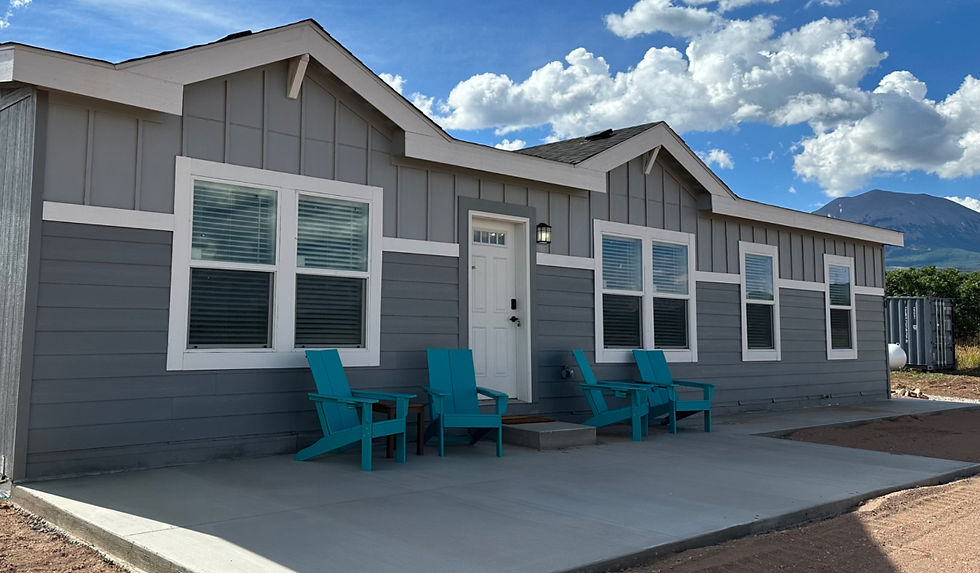
Stay in the main house and you have space to recover well — a full kitchen to rebuild your body after the climb, a living room to stretch out in, a porch where the mountains that tested you this morning now sit quietly in the evening light like old friends. Cook something real. Rest without noise. Let the stillness do its work.

Stay in the tiny home and let the simplicity sharpen you. Stripped down to what matters, you find that recovery is not complicated — rest, food, gratitude, and the long view of a mountain range you earned your right to call familiar. The tiny home is for the hiker who knows that less is often exactly enough.
Either way, you are waking up tomorrow in the La Sal Mountains — closer to the trails, the wildlife, the solitude, and farther from the crowds. Already, you stand ahead of every hiker who slept in Moab. The Moab Rim Trail is your proving ground. Deer Creek Retreat is your base camp.
As Duckworth reminds us, "You don't have to be the most naturally gifted in the room; you do have to be the one who keeps showing up" (Duckworth, Ch. 2). So show up. Set the alarm. Pack the water. Trust the cairns. And when you are standing on that slickrock platform above the Colorado River with the whole canyon world spread below you — you will know exactly what effort counts twice actually means.
Reserve your stay at Deer Creek Retreat — main house or tiny home — and come earn the Rim.
Find free grit resources, including a grit test, at GrittyGritGrit.com.
Cheers!
Justin
🥾 The Moab Grit Hikes Series
Mount Peale: Mount Peale Grit Hike: Effort Counts Twice on Southeast Utah's Highest Peak
Mount Tukuhnikivatz: Mount Tukuhnikivatz Grit Hike: How Gritty Are You on Moab's Iconic Skyline Peak?
Portal Overlook: Portal Overlook Grit Hike: Grow Your Grit Above the Colorado River
Moab Rim Trail: Moab Rim Trail Grit Hike: Effort Counts Twice on the Stairmaster
Gold Knob Trail: Gold Knob Trail: Grit, Grace, and the Long Game in the La Sal Mountains
Hidden Valley Trail: Hidden Valley Trail: A Sacred Hike Just "Inside" the Moab Valley Rim
Grandstaff Canyon: Grandstaff Canyon Grit Hike: The Long Obedience That Builds Morning Glory
🎒 Heading out on the trail? Download our Moab & La Sal High-Desert Survival Field Guide for instant mobile and printable access to our 1-gallon hydration formula, 12:00 PM lightning cut-offs, and 10-essential trailhead audits.
About the Author
The author holds a Ph.D. and is an ordained professional chaplain, specializing in the integration of motivation and choice theory, psychological resilience, and pastoral soul care. Transitioning from a ten-year active duty career as a Chaplain in the U.S. Army—where he served within the high-intensity environment of a critical care hospital—his work bridges empirical behavioral science with practical strategies for long-term identity formation. He serves as the primary researcher for grittygritgrit.com, a digital platform dedicated to helping individuals cultivate authentic perseverance through the profound transitions, traumas, and valleys of life. You can explore more of his work and high-mountain-desert writing at deercreeklasal.com.
Works Cited
Brown, Brené. Daring Greatly: How the Courage to Be Vulnerable Transforms the
Way We Live, Love, Parent, and Lead. Avery, 2012.
Duckworth, Angela. Grit: The Power of Passion and Perseverance. Scribner, 2016.
Dweck, Carol S. Mindset: The New Psychology of Success. Ballantine Books, 2016.
Keller, Timothy. Every Good Endeavor: Connecting Your Work to God's Work.
Penguin Books, 2014.
The Bible: The New King James Version. Thomas Nelson, 1982.


Comments