
Stories by the Campfire: The Old La Sal Sentinel
Updated: Jun 17
The legend of the Old La Sal Sentinel proves a simple truth about the high desert: when a town moves, not everything follows.

They’ll tell you the official story first. In the late 1920s, this little cow town tucked into the La Sal foothills on the south side of the mountain, started losing its fight with water. Spring runoff would swell the creek, but seasons turned fickle, and the low ground that once felt safe turned into a muddy gamble. Fields flooded. Roads washed out. Cellars filled like bathtubs left running too long.
So the town did what towns sometimes do when the land stops cooperating.
It got up and left.
Families hauled boards, furniture, fence posts—sometimes whole houses—up out of the basin to higher ground. Church, school, homes, corrals, even a few businesses eventually followed. New La Sal was born and grew where the creek behaved a little better and the winter was less harsh. Where it was easier to access the highway leading to Moab. The then La Sal stayed behind and became known as Old La Sal, a half‑drowned skeleton of streets, foundations, and root cellars slowly sinking back into sage and grass.
But no town ever leaves clean.
There’s always something left in the cracks—an old coffee cup, a broken wagon part, a story nobody bothered to write down. And if you listen to the campfire side of things, something else slipped into the empty space where human life used to be.
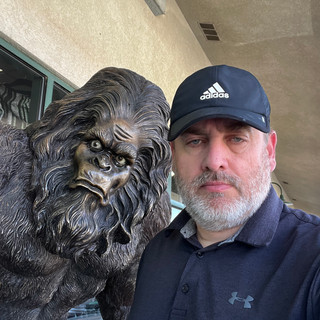
They call him the Sentinel.
According to the oldest version of the story, when the last real families hauled their lives uphill and Old La Sal was left with more flooded cellars than working front doors, a single figure wandered into the streets at twilight. Taller than any man in town. Shoulders wide enough to block a doorway. He moved slow, like he’d been watching from the tree line for years, waiting for the day the people finally gave up.
He walked the grid of the old town—down the main street, past the church foundation, between leaning fence posts, across the trampled grass that had once been yards and alleys. When he reached the lowest part of the basin, where the water pooled mean and brown, he stopped.
The cellars called to him.
You can still find them if you know where to look: half‑collapsed rectangles in the ground, lined with stone or rotting timbers, edges softened by time. That’s where the stories say the Sentinel took up residence—not in some glamorous cave high on a cliff, but in the abandoned root cellars of a town that decided it couldn’t stay.
He wasn’t there to haunt them.
He was there to guard them.
Over time, the legend settled into a kind of uneasy comfort. The Sentinel became less boogeyman and more watchman—something big and patient pacing the dry and dusty bones of Old La Sal so the last traces wouldn’t vanish unnoticed.
Then I moved back into his neighborhood.
Going Down to Debunk It
I’ll admit something I don’t usually put in the brochure: the first time I went down to the Old La Sal town site alone at dusk, I didn’t go as a believer.
I went as a skeptic with car keys in my pocket and a headlamp on my forehead, determined to walk those old foundations and prove to myself that all the talk of heavy, rhythmic footsteps was just wind and imagination. It felt like a grown‑up version of checking under the bed.
Down in the basin, it’s something else.
The road dropped away from the cabin, trading trees and shelter for open, sloping ground. The closer I got to the old town site, the more the air changed. The temperature dipped a few degrees. The breeze carried less pine, more wet earth and something metallic, like old nails and creek water.
I parked where the dirt track narrowed and stepped out into that half‑light that isn’t day anymore but isn’t quite night.
Instant regret.
There’s a kind of silence that feels like an empty room. This wasn’t that. This was a silence with weight to it, like the land was holding its breath.
My headlamp stayed off at first. I walked by the last thin wash of twilight, letting my eyes adjust. The outlines of Old La Sal emerged slowly: a low rectangle where a house foundation used to be, a line of fallen fence posts, a shallow depression that might have been a cellar.
I told myself I was just walking.
My heart didn’t buy it though.
Old La Sal Sentinel’s Footsteps
Suspense lives in the unseen, and the valley working its way to the canyon before the highway meets the Colorado boarder.
The first sound came quick and small: the snap of a branch somewhere above eye level. I froze. Deer break branches low, near their own bodies. This sounded higher, like something tall had brushed past a limb without trying very hard to be quiet.
“Probably just wind,” I muttered, because that’s what you say when you don’t want to turn around.
The second sign wasn’t even a sound. It was a feeling—a low vibration in the soles of my feet, like somebody had shut a heavy door a long way off and the tremor had taken the dirt road to get to me. Not enough to make rocks jump. Just enough to make my bones ask questions.
I stopped walking.
That’s when the footsteps started matching mine.
At first I thought it was just the echo of my own boots on gravel, a trick of acoustics in the open canyon. But the rhythm was off. There was a fractional delay, like another set of feet was a half beat behind me. Crunch. Crunch. Crunch.
I tested it. Took three steps forward, slow and deliberate.
Crunch. Crunch. Crunch.
Then I stopped dead in my tracks.
One more step came from somewhere off my left shoulder.
Just one.
The kind of extra step someone might take if they didn’t realize you’d halted.
Cold leaked into my arms. All the stories I’d ever heard about the Sentinel—guardian of the ruins, patient walker of the old streets—rushed in at once, wrestling with every rational part of me that wanted this to be a cow, a loose rock, anything but a deliberate presence.
I didn’t run. Pride is a stupid thing sometimes.
Instead, I did what you’re not supposed to do in horror movies: I spoke.
“Evening,” I said into the thickening dark, voice coming out rougher than I expected. “Just passing through.”
The footsteps stopped.
No rush of movement. No crash into the brush. Just the creak of old wood somewhere and the quiet hiss of the creek working its way through the lower ground.
My skin still crawled. But under the fear, something else pushed in—a sense that I hadn’t been stalked so much as sized up.
An Understanding at Dusk

Standing there between the ruins of Old La Sal, I suddenly understood why the oldest versions of the story don’t describe the Sentinel as a monster. Whatever was pacing those half‑erased streets at dusk felt less like a predator and more like a night watchman who’d caught me in his hallway.
It didn’t feel “okay.” The canyon still hummed with that primitive wrongness, that reminder that this low ground had soaked up more history than it’s ever going to give back. I still wanted my car keys, my porch light, and the safe glow of the cabin windows.
But it also didn’t feel entirely hostile.
If anything, it felt like I’d just walked into someone else’s home without knocking.
I turned slowly, scanning the shadows between the old foundations, and for half a second I thought I saw it—a slightly darker vertical shape against the failing light, too broad to be a fence post, too still to be a swaying branch.
I blinked, and it was gone.
The valley didn’t relax when I turned back toward the road, but it didn’t tighten either. I walked out the way I’d come, boots careful on the gravel, listening for that extra step that would mean I was being followed.
Nothing.

By the time I reached my car, the first stars were pushing through the sky. The lights of the cabin at Deer Creek Retreat glowed faintly up the slope, a small island of human warmth in a lot of old, indifferent space.
As I drove back toward the cabin, I realized the resolution wasn’t going to be a neat “it’s all okay” or “it was just the wind.”
The truth was stranger and somehow more satisfying: the Sentinel and I had an understanding.
The town might have moved, but something stayed behind to walk its edges. My job wasn’t to own that story or debunk it. My job was to respect the boundary between the cozy safety of the cabin and the heavy, watchful quiet of the basin at dusk.
Up here, not all guardians wear badges.
Some of them just keep making their rounds, long after the last front door closed—and if you’re going to wander their streets at the edge of dark, the least you can do is nod and say hello.
Guests who stay at Deer Creek Retreat sometimes come back from the wild west Old La Sal ghost town site at dusk with their own stories—heavy, rhythmic footsteps in the basin, a single extra crunch in the gravel when they’ve already stopped walking, the feeling of being quietly watched on their way back to the car. Whether it’s an old cattleman still checking his herd or the Old La Sal Sentinel making his rounds, if you stay here long enough, you’ll have to decide for yourself who’s out there keeping track.
Come out and visit us in Old La Sal, try the spacious main cabin or the tiny home, you won't regret what the remote area has to offer!
Cheers!
Justin
About the Author
The author holds a Ph.D. and is an ordained professional chaplain, specializing in the integration of motivation and choice theory, psychological resilience, and pastoral soul care. Transitioning from a ten-year active duty career as a Captain in the U.S. Army—where he served within the high-intensity environment of a critical care hospital—his work bridges empirical behavioral science with practical strategies for long-term identity formation. He serves as the primary researcher for grittygritgrit.com, a digital platform dedicated to helping individuals cultivate authentic perseverance through the profound transitions, traumas, and valleys of life. You can explore more of his work and high-mountain-desert writing at deercreeklasal.com.


Comments