
Stories by the Campfire: The “Coyote Creek” Mimic (A La Sal Mountains Bigfoot Story)

Updated: Jun 20
There is a specific kind of La Sal Mountains Bigfoot story that shows how true mountain solitude does strange things to the human senses. Out here, the night is heavy and alive — almost sentient. You hear things that don’t quite belong, smell the lingering smoke of a campfire that’s gone out, and swear you can feel the earth shift beneath your boots as if breathing. When guests ask me what they can expect during their stay at Deer Creek Retreat, I tell them this: the silence isn’t empty — it’s sacred, it’s old and full.

Locals around Moab say the hills hold their secrets. Some tell stories about miners who never came home, others mention the wandering spirits of pioneer families that camped near Coyote Creek more than a century ago. But there’s one legend that always comes up around the fire — the Coyote Creek Mimic, a creature that doesn’t hunt as much as it haunts.
They say it’s a type of Bigfoot, though not quite like the towering, shadowy shape people report from the Pacific Northwest. This one is quieter. Smarter. Some say it listens first — studying campers before deciding what voice to borrow. Supposedly, it mimics the sound of someone crying for help, or sometimes, eerily, calling your name.
La Sal Mountains Bigfoot story
I remember my first encounter with the legend as clearly as if it happened last week. It was late June, and the canyon was full of wildflowers and runoff water from the melting snowcaps. My buddy Jake had just finished telling one of those “famous” Moab campfire stories about ghostly miners whose lanterns never quite go out. He poked at the fire and said, half-joking, “If Bigfoot’s real, I’d bet he lives up here too. No people. No cell service. Just room to disappear.”
We laughed, but there was something in the way the firelight flickered across the trees that made me look twice. The night was layered with noise — crickets, far-off yips from coyotes, and the occasional gust that rattled the leaves like gentle applause. Still, beneath all that, I felt something deeper — an awareness that we were being watched.
Then we heard it.
The First Call
At first, it sounded like a woman’s voice echoing down the canyon. It wasn’t sharp or desperate, more like a single word, stretched long by distance — help. Jake stood up, his face tilted toward the sound.
“You hear that?” he asked.
We listened. Nothing. Just the soft hum of the breeze. Then again — clearer this time. Help me.

The voice came from beyond the tree line, down where Coyote Creek snaked through the valley. We grabbed a lantern and started walking, our boots sinking in the damp earth as the firelight faded behind us. I can still remember how the darkness thickened like fog, swallowing the stars. The air smelled mineral, metallic — like river stones and rain.
After only a few hundred yards, the voice called again, but it didn’t sound quite right anymore. There was an odd rhythm to it, a second voice beneath it, something deep and throaty that felt more like a growl than speech. Jake froze. “That’s not a person.”
We turned back, and as we did, the voice shifted pitch — higher now, closer, as if circling us. The lantern flickered and went out.
I don’t remember running, but we must have. I remember the campfire breaking through the dark like a beacon, the relief of its light, the first warm breath after ice. We didn’t sleep the rest of that night.
What the Locals Say
The next morning, we drove into town for coffee, still jumpy and trying to rationalize it — a trick of sound, an echo bouncing off canyon walls. The waitress at the café, a lifelong La Sal resident, listened quietly, then nodded.
“You boys were near Coyote Creek, right?” she said. “They call it the ‘Mimic.’ Folks’ve heard it for years — sometimes cries, sometimes laughter. You look too long into that canyon, it looks back.”
She wasn’t smiling.
Later that day, an older rancher told us his story. He’d been camping alone near the same creek decades ago when he heard what he thought was his brother calling him from the dark. His brother had died years earlier.
He followed the voice down toward the water. When he reached the creek, the sound stopped, and he felt an odd vibration under his feet — like the earth humming. Then, on the ridge above him, something large crossed between two trees, upright, gray-black, and moving with the smoothness of water.
When he shone his flashlight toward it, all he saw was steam — thick, swirling, and gone within seconds.
The Mystery Deepens
Stories like that spread quietly around Moab, passed in half-whispers at gas stations, trailheads, and local diners where the coffee always tastes faintly of pine smoke. You won’t find the Coyote Creek Mimic in any official guides or park brochures. Still, ask long enough, and someone will lower their voice, lean across the table, and say, “I heard it too.”
Almost everyone claims to know a friend — or the cousin of a friend — who was camping up near La Sal Pass when they heard human laughter echoing through the trees at two in the morning. No footprints. No signs of anyone else around. Just laughter that faded into a low growl before vanishing completely.
Researchers tracking down every credible La Sal Mountains Bigfoot story sometimes tie these tales to those odd vocal recordings captured in remote corners of Washington or Ohio — those unsettling clips where laughter stretches too long, where words sound almost human but fall just short, warped by distance or instinct. Scientists dismiss it as owls or cougars, or what they call audio pareidolia — the mind’s habit of stitching familiar patterns into chaos. Maybe they’re right.
But the people who’ve spent time in these canyons tell you it’s not that simple. Out here, sound behaves like it has a mind of its own. The red rock walls of San Juan County catch a voice and sling it back at you from a dozen directions at once. A shout from the rim can arrive at the valley floor stretched, distorted, and disembodied — a ghost of the original cry, stripped of warmth and shaped by stone.
On certain nights, when the air is dry and cold, even your own breath seems to echo wrong — a half beat too late, or answering from somewhere behind you. The locals say that’s when the Mimic listens. That’s when it learns.
Think about that for a moment: if something wanted to borrow your voice, to study the cadence and tone until it wore it like a mask, could there be a better teacher than this canyon? Its walls don’t just throw sound — they reshape it. The landscape itself becomes an accomplice, molding the ordinary into the uncanny.
Once, a hiker told me he recorded what he thought were birds calling from a nearby ridge. When he played it back that night at the trailhead, he heard his own name whispered in between the chirps — soft, deliberate, and unmistakably human. He never camped in that canyon again.
So, is it just the wind? Maybe. But maybe it’s something older, something that’s learned to speak our language one echo at a time. Out here, the silence isn’t empty. It’s listening. And sometimes, when we least expect it, it decides to answer.
Solitude and Wonder
What fascinates me most about the legend isn’t the fear — it’s the solitude. Bigfoot, according to most stories, craves seclusion. And isn’t that why we come to these mountains, too? To disappear for a while, to breathe air unbothered by traffic or timelines, to reconnect with something wild and wordless. This local legend is less a standard La Sal Mountains Bigfoot story and more a reflection of that deep primal craving — that primal part of us that listens for voices in the wind.
Sometimes, around our evening fires at Deer Creek Retreat, guests say the silence feels “charged.” They’ll tilt their heads and ask, “Did you hear that?” Usually, it’s just a coyote or an owl calling from the timberline. But every now and then, when the night drapes heavy, and the flames burn low, you can almost imagine a whisper threading through the dark — one syllable, fragile, asking for help.
For the Brave and the Curious
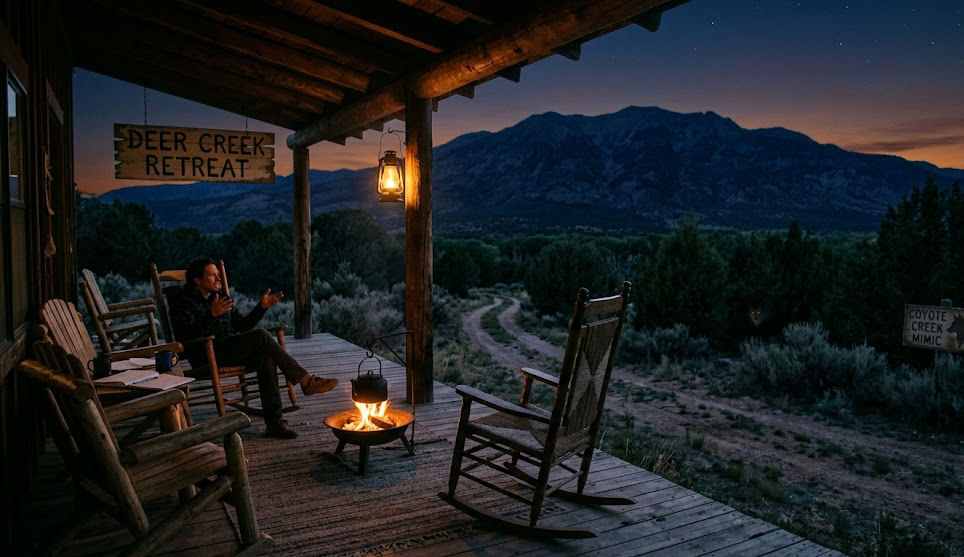
If you’re staying with us this weekend, make time for a campfire-style story; we might call it front porch tales. Bring your stories, your laughter, and your willingness to believe in what can’t be seen. The Coyote Creek Mimic is part of the wild fabric of this place — something that reminds us the world still holds wonder and mystery, even when we’ve mapped every inch of it.
So tonight, when you’re sitting around on the porch with the stars stretching overhead and the mountains breathing softly around you, listen closely. If you hear your name whispered from the dark, don’t worry — it’s probably just the wind. Probably.
The Challenge
Now, here’s where I’ll leave a challenge for the brave ones reading this. If you’ve made it this far — if you’ve felt the goosebumps rise and the curiosity build — maybe you’re the kind of soul the Coyote Creek Mimic calls to. A little daring. A little curious. Someone who wants to test what’s real and what’s imagination when the firelight flickers low.
So here’s your invitation — no, your dare.
Spend a night at Deer Creek Retreat, in either the main cabin or tiny home, under a La Sal moon. Bring a story of your own to share by the campfire. When the air cools and the ridges darken, sit quietly for a while. Let the silence speak. Listen for the small, unexpected things — the rustle of leaves, the distant cry that doesn’t sound quite like a coyote, the voice that seems to say your name from beyond the creek bed.
If you hear something you can’t explain, write it down. Tell us what you think it was. Post your story. Pass it on. That’s how legends live — not in dusty archives, but in the ears and hearts of those willing to believe, even just a little.
Whether you find the Mimic or just the sweet peace of still mountain air, you’ll walk away with something real — a connection to the wild, a memory that hums under your skin like a secret.
And remember, every great Moab campfire story starts somewhere, with someone who decided to listen when the night whispered back.
Cheers!
Justin
About the Author
The author holds a Ph.D. and is an ordained professional chaplain, specializing in the integration of motivation and choice theory, psychological resilience, and pastoral soul care. Transitioning from a ten-year active duty career as a Captain in the U.S. Army—where he served within the high-intensity environment of a critical care hospital—his work bridges empirical behavioral science with practical strategies for long-term identity formation. He serves as the primary researcher for grittygritgrit.com, a digital platform dedicated to helping individuals cultivate authentic perseverance through the profound transitions, traumas, and valleys of life. You can explore more of his work and high-mountain-desert writing at deercreeklasal.com.


Comments