
Living in Old La Sal Utah: What High Desert Silence Teaches Us

Updated: Aug 18
If you spend enough time living in Old La Sal Utah, you begin to realize that the silence out here isn't just an absence of city noise—it is an active, living presence.
In our fast-paced modern world, we spend our days navigating an endless barrage of notifications, strict calendar blocks, and artificial environments engineered for total predictability. We react instead of reflect. We manage daily inputs instead of asking deeper questions about where we are going, how we are healing, and why we do the work we do.
Throughout our Ancient Spirits series, we have journeyed through the remote canyon corridors surrounding Moab. We walked into the shadowed alcoves of Horseshoe and Sego Canyons, stood beneath the towering, red-ochre figures of Barrier Canyon rock art, examined the chemistry of ancient iron-oxide pigments, and debated the competing theories behind those unblinking stone guardians.
Now, in this series finale, we step back from the trailheads and look at the larger picture. What does proximity to thousands of years of human memory teach us about ourselves? And why does the high-altitude quiet of Old La Sal offer such a vital sanctuary for the modern human spirit?
Living in Old La Sal Utah: Where History Meets Solitude
To understand the unique character of this landscape, one must look at the distinct contrast between downtown Moab and the elevated basin of Old La Sal.
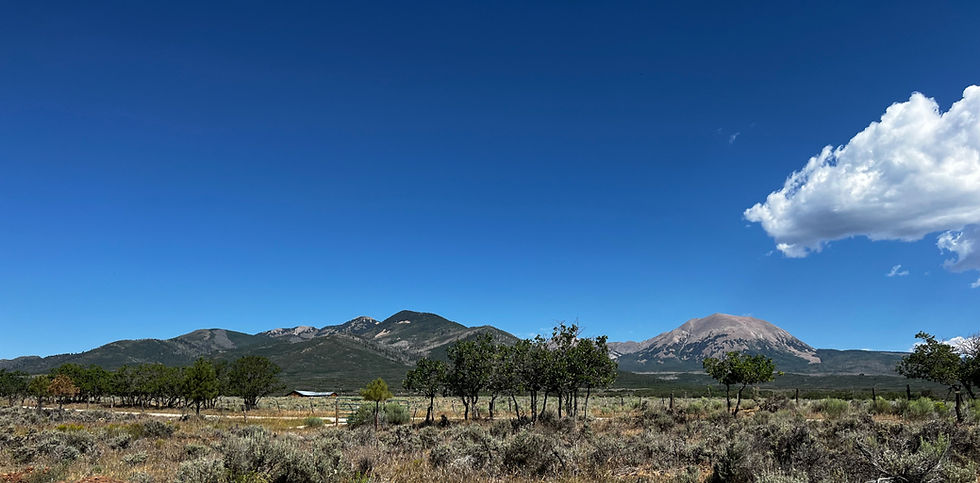
Downtown Moab carries a vibrant, high-energy pulse. It is practical, active, and filled with travelers seeking adventure on red rock trails, steep slickrock passes, and river rapids. But as you leave the highway, turn off toward the La Sal Mountains, and climb into the basin near Deer Creek, the atmosphere transforms completely. The air thins, the sagebrush opens up, and the noise of civilization simply drops away.
The Duality of the High Desert
Downtown Moab: High-energy, motion-driven, focused on outdoor recreation, and filled with constant activity.
Old La Sal Basin: High-altitude, stillness-driven, focused on reflection and dark skies, providing the mental space needed to unclench and process thoughts.
When you spend time in this basin, you aren't just looking at scenery; you are stepping into scale. Rising dramatically above the red sandstone floor, the La Sal Mountains stand like silent sentinels. They anchor the basin, catching the last amber rays of sunset and holding the morning light long before the lower canyons wake up.
Proximity to these mountains changes how you experience time. Life stops moving at the pace of a smartphone notification and starts moving at the pace of breath.
The Physiology of Desert Quiet: High Altitude and Nervous System Recovery
The restorative power of living in Old La Sal Utah isn't just a poetic sentiment; it has a direct, physiological impact on the human body.
Sitting at an elevation above 6,000 feet, the La Sal basin offers a rare atmospheric combination: thin mountain air, low humidity, and zero artificial light pollution. When you step away from urban center humidity and city smog, your respiratory and nervous systems experience a swift recalibration.
1. Atmospheric Pressure & Respiration
High-altitude air forces slower, more deliberate breathing patterns. Without realizing it, visitors begin taking deeper diaphragmatic breaths, which stimulates the vagus nerve—the primary driver of the body's parasympathetic (rest-and-digest) system.
2. Melatonin Reset Under Dark Skies
Artificial blue light from streetlamps and indoor lighting suppresses the human body's natural melatonin production, disrupting deep REM sleep cycles. In Old La Sal, when the sun drops behind the La Sal Mountains, total natural darkness settles across the basin. Without light pollution, your brain naturally syncs with circadian rhythms, promoting deep, restorative sleep that is virtually impossible to achieve in a lit city.
3. The Acoustic Void
In modern urban settings, your brain is constantly filtering out ambient low-frequency hums—traffic, HVAC units, electrical lines, and sirens. Even while sleeping, your auditory cortex works continuously to monitor these background noises for potential threats. In the high desert, background decibels drop to near absolute zero. This acoustic void signals to the amygdala that it is safe to drop hyper-vigilance, allowing muscle tension in the shoulders, neck, and jaw to release.
Early Post-Dispersal Human History: Living with Intent
To view the ancient rock art surrounding Old La Sal through a grounded, post-dispersal historical framework is to gain a deeper respect for human resilience.
Following early post-Flood migrations, early human societies adapted to extreme arid environments across North America. These ancestors were not crude or unintelligent; they were master survivalists, observers of nature, and skilled artists who possessed an intimate knowledge of local geography, seasonal hydrology, and mineral chemistry.
Early Adaptations in the La Sal Basin
Micro-Climate Agriculture: Early inhabitants understood how to utilize natural runoff from snowmelt along the slopes of the La Sal Mountains to cultivate crops in dry wash basins long before modern irrigation existed.
Sandstone Shelter Utilization: Shallow alcoves were strategically chosen not only for protection against extreme weather, but for their thermal mass—absorbing solar heat during the day and radiating warmth back into the shelter during freezing desert nights.
Permanent Cultural Markers: The red-ochre paints applied to cliff walls were manufactured with long-term intent. Early artists mixed iron oxide minerals with animal fats and plant binders to ensure their spiritual expressions, territorial boundaries, and historical records would endure across generations.
Standing before a figure painted centuries ago in Horseshoe Canyon reminds us of our own impermanence. It strips away the illusion that our current digital generation is the center of history. It forces us to acknowledge that humans have walked these exact canyon paths, faced profound hardships, and sought meaning under these exact dark skies long before our modern highways were paved.
Attention Restoration: The Science of High Desert Solitude
Psychologists and environmental researchers often talk about a phenomenon known as Attention Restoration Theory (ART).
In modern life, we rely heavily on directed attention. Every time you read an email, navigate heavy traffic, scroll through social feeds, or make rapid decisions at work, your brain draws from a strictly finite pool of cognitive energy. Over time, this constant drain leads to mental fatigue, heightened irritability, and a persistent, low-grade stress response.
Natural environments like the La Sal basin engage a completely different type of attention: soft fascination.
Effortless Engagement: Watching the shadow of a cloud drift slowly across a red sandstone ridge requires zero mental strain.
Sensory Reset: Listening to the evening breeze move through the sagebrush or watching stars ignite overhead allows the brain's analytical centers to rest.
Nervous System Downshifting: Without artificial dings, alarms, or visual clutter demanding an immediate response, the body naturally transitions out of fight-or-flight mode and into deep recovery.
The deep quiet of Old La Sal isn't an empty void; it is an active healing environment. It gives your mind permission to process accumulated thoughts, restore depleted attention spans, and reconnect with internal clarity.
The Landscape as a Mirror for Soul Care
In my work specializing in pastoral soul care, human motivation, and psychological resilience, I have seen how essential physical scale is for emotional healing.
When we carry grief, severe burnout, or heavy life transitions, carrying them in a crowded, noisy environment can feel suffocating. Our problems feel all-consuming because our immediate surroundings are small, cramped, and loud.
To regain perspective, the human spirit requires contrast. It needs vast environments—places where the immense scale of the landscape gently forces our self-importance and anxieties to shrink back down to size. The high desert doesn't erase our hardships; it gives us space to carry them without being crushed by them.
The Practice of Stillness: Sitting with Mystery
Throughout this series, we have wrestled with unanswered questions:
Who were the ancient artists of Barrier Canyon?
Why did they paint such eerie, limbless forms with hollow, unblinking eyes?
What experiences were they recording on those remote cliff walls?
When you sit on the porch at Deer Creek Retreat after dark, watching a star-filled sky that stretches endlessly from peak to horizon, you are practicing humility. You are acknowledging that reality is far older, wider, and more complex than our neat theories allow. You are allowing yourself to be small in a very large universe—and discovering that being small isn't frightening; it is profoundly liberating.
Practical Sanctuary: Structuring Your Evening at Deer Creek Retreat
To truly capture the restorative benefits of living in Old La Sal Utah during your stay at Deer Creek Retreat, disconnecting requires a small, intentional shift in routine.
While Deer Creek Retreat offers Wi-Fi to keep you connected when necessary, cell service disappears as you enter the Old La Sal basin. Far from being an inconvenience, this digital boundary is your greatest amenity.
Here is how to structure your arrival evening for maximum rest:
Step 1: The Device Sunset
When you pull up to the property, turn off your mobile devices or set them to airplane mode. Place your phone inside a drawer inside the cabin or tiny home to remove the visual trigger of checking for notifications.
Step 2: The Porch Adjustment Period
Step outside onto the open air porch of the Main Cabin or the gravel seating area by the Tiny Home. Sit quietly for 20 to 30 minutes without reading or listening to music. Allow your eyes to adjust to the softening evening light as the sun fades behind the sandstone ridges.
Step 3: Analog Stargazing
It takes human eyes roughly 25 minutes to fully adapt to true dark skies. Once night falls, look up at the Milky Way without checking a screen. Notice how many stars emerge as your vision adapts to the unpolluted darkness.
Exploring Remote Canyons? Grab the High-Desert Field Manual ($2.99)
Heading off-grid to explore Barrier Canyon rock art or Horseshoe Canyon? Download our complete Moab & La Sal High-Desert Survival Field Guide—featuring our 1-gallon hydration formula, 12:00 PM alpine lightning rules, slot canyon flood protocols, and 10-essential trailhead audit checklist. Includes both a mobile PDF for your phone and a printable edition for your daypack.
Your Basecamp for Reflection at Deer Creek Retreat
Whether you come to southeastern Utah to hike remote canyons, photograph ancient petroglyphs, or simply escape the relentless noise of daily life, Deer Creek Retreat was built to offer true sanctuary.
Located in the quiet heart of the La Sal basin, just 40 minutes up US-191 south of Moab, our property provides a front-row seat to high desert dark skies and mountain stillness:
The Main Cabin
Spacious, warm, and inviting, the Main Cabin features expansive open aire porch designed specifically for slow mornings and quiet evenings. Sit with a warm mug of coffee or tea as the morning sun illuminates the La Sal mountain peaks, or gather with family after a day of canyon hiking to watch the shadows stretch across the basin floor.
The Tiny Home
For solo travelers, couples, or anyone seeking a minimalist footprint, the Tiny Home offers an intimate retreat experience. Step out onto your private gravel seating area, turn off the interior lights, and let your eyes adjust to an unbroken canopy of stars unpolluted by city glow.
Bringing the Ancient Spirits Journey Home
As we wrap-up this series, the invitation remains open:
Step Off the Map: Take time to explore the ancient panels of Horseshoe and Sego Canyons with open, respectful eyes.
Practice the Pause: Put down your camera and phone for five minutes at each site, letting the atmosphere of the land settle around you.
Embrace the Silence: Return to Old La Sal, turn off the engine, step out onto the porch, and let the high desert speak for itself.
The stories carved into the sandstone centuries ago were not meant to be analyzed from afar—they were meant to be witnessed. And sometimes, witnessing mystery is the very thing that restores our soul.
The Ancient Spirits Series Recap:
Part 1: The Eyes in the Sandstone (Encountering Barrier Canyon Art)
Part 2: Shamanic Trance or Ancient Visitors? (Archaeology & Theories)
Part 3: Visit Horseshoe Canyon from Moab (Respectful Travel Guide)
Part 4: Living in Old La Sal Utah (What High Desert Silence Teaches Us)
Reserve Your Sanctuary Today!
Ready to experience the dark skies, mountain views, and quiet solitude of Old La Sal? Reserve your stay at the Main Cabin or Tiny Home visit our website at deercreeklasal.com for more information.
Cheers,
Justin
About the Author
Justin holds a Ph.D. in Education and is an ordained professional chaplain, specializing in the integration of motivation and choice theory, psychological resilience, and pastoral soul care. He previously served ten years on active duty as a U.S. Army Chaplain in a critical care hospital, where he learned to sit with people in their deepest valleys and darkest nights.
He is the primary researcher and writer for grittygritgrit.com, a platform focused on perseverance, identity formation, and growth through adversity. Explore more reflections and resources at deercreeklasal.com.


Comments