
The Ochre Hands: A Story of Ancient Rock Art History Utah
Updated: Aug 18
Author’s Note: This story is a piece of historical fiction. While grounded in archaeological research surrounding pigment chemistry, post-dispersal human adaptation, and regional geography, it is a creative narrative designed to explore the human hearts behind ancient rock art history in Utah.
Part I: The Coming Cold: Ancient Rock Art History Utah
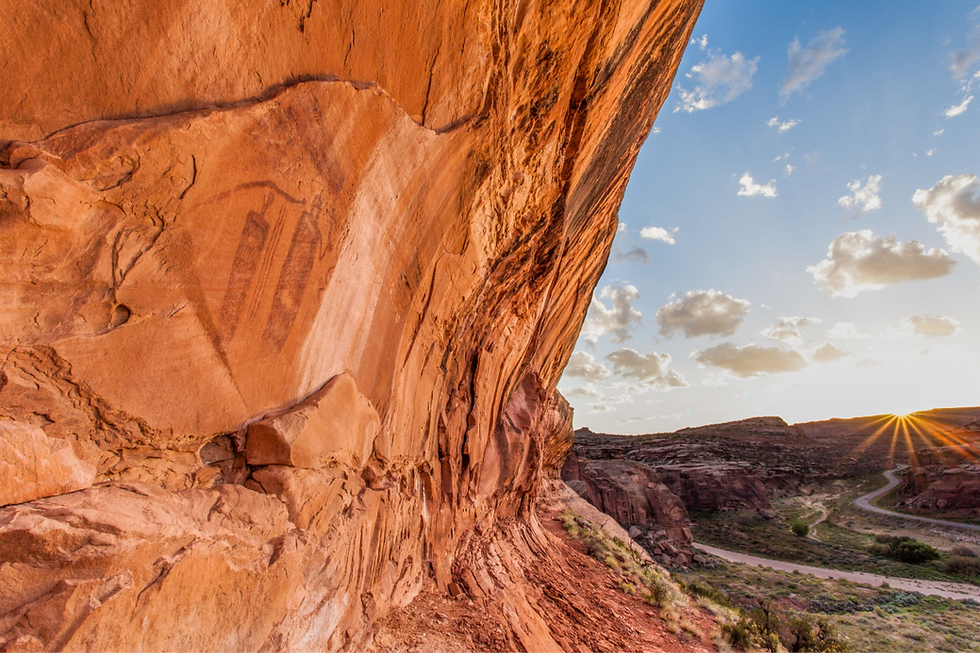
The autumn wind coming off the high peaks of the La Sal Mountains did not merely blow; it bit. It carried the sharp, thin scent of cedar smoke, dry sage, and the unmistakable metallic cold of snow sitting just beyond the upper ridges.
In the softening dusk, the high basin below opened up into a vast sea of shadow and muted grey sagebrush. High above the floor of the dry wash, tucked deep inside a alcove of Wingate sandstone, a man knelt on the stone.
His name has long since faded from human memory, swallowed by the centuries, but his hands knew the land with an intimacy that modern humans can scarcely imagine. He knew which canyon benches held hidden springs during dry summers. He knew the precise day the piñon nuts would drop from their cones. And he knew the mood of the mountain clouds before the first drop of rain ever struck the red dust.
Beside him lay his raw materials, carefully arranged on a strip of cured deer hide:
A flat, heavy quartzite grinding stone worn smooth by years of friction.
Two dried gourds filled with rendered mountain sheep tallow and marrow fat.
A tightly bound bundle of processed yucca fibers, pounded soft and trimmed into crude brushes.
Several fist-sized chunks of heavy, dark, blood-red hematite gathered from a high ridge days earlier.
The Ancient Pigment Process
Ingredient | Purpose |
Crushed Hematite (Iron Oxide) | Provides deep, light-fast red color |
Animal Fat & Marrow Binders | Adheres pigment securely to raw sandstone |
Plant Juices & Water | Creates fluid brushability for application |
Winter was coming to the high basin. His small kin-group—twelve souls in all, spanning three generations—had already begun moving down from the summer hunting camps into lower, protected canyon shelters where the bitter drafts could not trapped them. Their caches were filled. Dried elk meat, ground grass seeds, and woven baskets of piñon nuts were sealed safely inside dry rock crevices.
The physical work of survival for the coming season was finished. But before the heavy snows sealed the high mountain passes and cut off the basin from the southern valleys, a final, essential work remained.
Exploring Remote Canyons? Grab the High-Desert Field Manual ($2.99)
Heading off-grid to explore Barrier Canyon rock art or Horseshoe Canyon? Download our complete Moab & La Sal High-Desert Survival Field Guide—featuring our 1-gallon hydration formula, 12:00 PM alpine lightning rules, slot canyon flood protocols, and 10-essential trailhead audit checklist. Includes both a mobile PDF for your phone and a printable edition for your daypack.
Part II: The Alchemy of Iron and Stone
The man picked up the largest chunk of hematite. The stone was dense, heavy for its size, and cold against his dirt-stained fingers. Its surface glinted dully in the fading ambient light—rich with concentrated iron oxide.
He placed the stone in the center of the quartzite slab and picked up a rounded hammerstone. He did not strike blindly. With measured, rhythmic taps, he crushed the chunk into smaller, pea-sized fragments.
Clack. Clack. Crush.
The sharp metallic ringing echoed softly off the curved ceiling of the sandstone alcove, blending with the evening wind rustling through the scrub oaks in the wash below.
Once the stone was broken down, he leaned his body weight forward, pressing the grinding stone over the fragments in long, deliberate strokes. Scritch, slide. Scritch, slide.
Dust began to rise—a fine, dark red powder that settled into the creases of his palms, stained his fingernails, and coated the skin of his forearms. He breathed it in, tasting the sharp, copper-like flavor of the earth on the back of his tongue.
For nearly an hour, as the sun dipped behind the western ridges and turned the sky from amber to deep violet, he ground the stone. He ground it until there were no grit, no pebbles, and no rough edges left—only a powder so fine it felt like silk between his thumb and forefinger.
From his waist pouch, he drew a small clay flask filled with water hauled up from the spring that morning. He poured a small stream into the center of the red powder, followed by two generous scoops of soft sheep fat. Using a smooth river pebble, he worked the mixture together.
The fat bound the iron minerals, creating a thick, dark, glossy paste that smelled of earth, animal tallow, and cold water.
This was not casual decoration. This was chemistry born of generations of trial and error. Water alone would wash away with the first spring thunderstorm. Charcoal would fade under the fierce high-desert sun. But iron oxide mixed with animal fat would sink deep into the porous matrix of the sandstone, binding to the rock itself as it cured. It was a paint meant to outlast flesh, bone, and memory.
Part III: The Guardians on the Wall
The man stood up, his knees popping in the quiet of the alcove. His back was stiff from hours of bending over the grinding stone, but his eyes were focused. He turned to face the back wall of the shelter.
The rock face was a smooth, vertical panel of reddish-orange sandstone, sheltered from rain and direct snow by the deep overhang above. It had been swept clean with a bundle of dried grass hours earlier.
He picked up his thickest yucca brush, saturated the fibers in the dark ochre paste, and stepped up to the rock.
He did not hesitate. There was no sketch, no outline drawn in charcoal. The image had lived in his mind for months, refined through winter nights around the hearth fire and long days spent hunting alone in the shadow of the La Sal peaks.
He touched the brush to the stone.
With a slow, sweeping downward motion, he drew the outer boundary of a central figure. It was monumental in scale—taller than a tall man, wide at the shoulders, and tapering smoothly downward into a narrow, legless base that seemed to float above the shelter floor.
He filled the body with intricate, vertical lines, working meticulously from top to bottom. Each line represented rain falling from heavy clouds—the lifeblood of the high desert basin. Between the rain lines, he painted tiny, delicate zig-zags symbolizing the movement of snakes and the sudden flash of lightning across the summer sky.
At the top of the torso, he shaped a broad, rounded head. He gave it no mouth to speak, no ears to listen to human squabbles, and no arms to hold weapons. Instead, he painted two wide, hollow, unblinking eyes that stared straight out across the valley basin toward the eastern mountains.
For hours, as twilight dissolved entirely into a cold, moonlit night, the painter worked in near silence. When his brush ran dry, he dipped his fingers directly into the pigment bowl, using his fingertips to smooth the edges and apply delicate dots of red across the chest of the figure like a chest-guard of bone beads.
His shoulders burned with exhaustion. The freezing night air bit at his bare toes and stiffened his hands until it was hard to grip the yucca handle. But he did not stop. He painted two smaller, companion figures flanking the central guardian—spectral forms that hovered in silence, watching the entryway of the canyon.
Part IV: The Mark of Presence
When the three figures were complete, the painter stepped back to the edge of the alcove to catch his breath. His breath bloomed in pale, white clouds against the dark sky.
The red ochre glistened wetly on the rock under the silver light of the waxing moon. The figures did not look like paintings; in the shifting shadows, they looked like living, breathing entities that had stepped out from inside the cliff itself to keep watch over the basin.
There was only a small pool of dark red paste left in the bottom of his stone grinding bowl.
He set his brushes down on the hide wrapper. He looked at his right hand—stained deep crimson from palm to knuckle. Slowly, deliberately, he dipped his entire palm into the bowl, coating his hand in a thick, uniform layer of the iron paste.
He stepped back up to the rock face, right beside the shoulder of the central guardian figure.
He took a deep breath, raised his hand, and pressed his palm firmly against the raw sandstone. He held it there for three slow heartbeats, feeling the cold transfer from the rock into his skin, pressing hard enough to force the pigment into every crevice and grain of the stone.
When he pulled his hand away, the sharp, unmistakable imprint of a human hand remained—the thumb extended, five fingers spread wide, the palm flat and clear.
It was not a symbol. It was not a spirit guide. It was an assertion: I was here. I breathed this air. I walked this ground. I loved this land.
Part V: The Unbroken Watch
The man cleaned his tools in silence, wiping his grinding slab with dry sand and packing his hide bundle. He wiped his crimson hand against his leather tunic, leaving a faded red smear over his chest, but he did not wash it. The pigment would wear off in time, over days of skinning game and gathering firewood.
He stood at the lip of the sandstone alcove for a long moment, looking out across the vast, dark basin.
Below him, miles away near the base of the mountain pass, a tiny pinprick of orange light flickered in the darkness—the hearth fire of his family's camp. He could imagine his children wrapped in rabbit-skin robes, listening to the elders tell stories of the grandfathers who walked the earth before the great drying.
He looked back one last time at the wall. The red figures held their unblinking watch, dark against the orange stone.
He knew that when the heavy winter snows melted in the spring, and his people returned to the high basin to hunt and gather, they would climb up into this alcove. They would see the guardians on the wall. His children would step up to the rock, place their small hands over his ochre print, and know that they belonged to this place—that they were anchored to something far larger and older than their immediate fear of the cold.
The painter turned, adjusted his hide pack, and stepped out of the alcove, descending into the dark wash toward the warm glow of the fire below.
Behind him, high on the sandstone wall, the iron oxide began its long, slow cure into the rock—beginning a watch that would endure through snows, droughts, generations, and centuries, long after the painter's name was lost to the wind.
Reflection & Visiting the High Desert
When you stand before ancient panels today—whether exploring remote canyon wash corridors or gazing up at the La Sal Mountains from the porch at Deer Creek Retreat—you are looking across a bridge of time.
The people who painted these alcoves were not figures in a textbook; they were human beings who felt the cold wind, loved their families, and sought to leave a lasting mark of presence in an immense, challenging landscape.
Explore the Ancient Spirits Series:
Part 1: The Eyes in the Sandstone (Encountering Barrier Canyon Art)
Part 2: Shamanic Trance or Ancient Visitors? (Archaeology & Theories)
Part 3: Visit Horseshoe Canyon from Moab (Respectful Travel Guide)
Part 4: Living in Old La Sal Utah (What High Desert Silence Teaches Us)
Special Feature: The Ochre Hands (Historical Fiction)
Plan Your High Desert Stay:
Thousands of years ago, people stood in this high basin and looked up at these exact same stars. Stop scrolling through scenery and come experience the wild quiet of the La Sal Mountains for yourself—whether you need space for the whole family in our Main Cabin or a quiet, minimalist escape in our Tiny Home.
Your high-desert sanctuary is waiting at deercreeklasal.com.
Cheers,
Justin
About the Author
Justin holds a Ph.D. in Education and is an ordained professional chaplain, specializing in the integration of motivation and choice theory, psychological resilience, and pastoral soul care. He previously served ten years on active duty as a U.S. Army Chaplain in a critical care hospital, where he learned to sit with people in their deepest valleys and darkest nights. He is the primary researcher and writer for grittygritgrit.com, a platform focused on perseverance, identity formation, and growth through adversity. Explore more reflections and resources at deercreeklasal.com.


Comments