
Tracing the Old Spanish Trail Near Moab

Updated: Aug 18
When you trace the historic trade routes of the American Southwest, exploring the history of the Old Spanish Trail near Moab, it reveals one of the most physically demanding, high-stakes overland corridors in North American history.
Today, modern travelers cross the Colorado River near Moab via a bridge on US Highway 191. We travel at sixty miles per hour (well, the county marked 191 down to 45 mph crossing the bridge and into town) inside climate-controlled vehicles with air conditioning, satellite radio, and digital maps updating our routes in real-time. We view the towering red sandstone canyons as scenic natural monuments to be photographed from paved turnouts or passed through on our way to regional national parks.
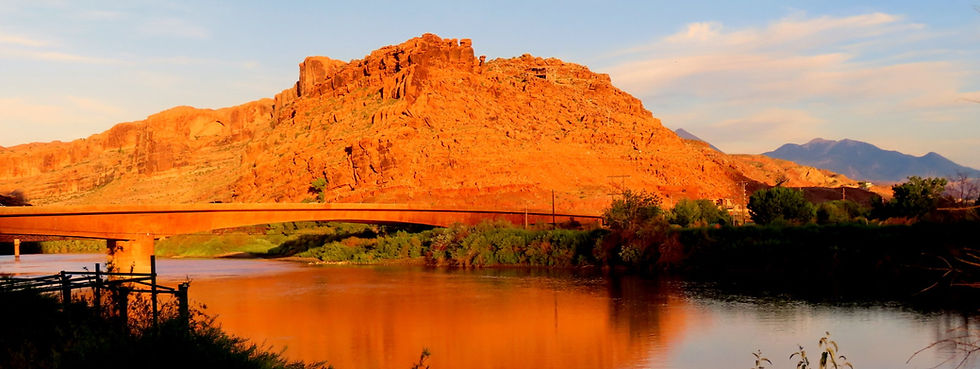
But during the early 1800s—and for centuries prior along ancient indigenous trade routes—crossing this exact stretch of the Colorado River was a high-stakes, life-or-death logistical enterprise.
There were no bridges, no paved approaches, and no emergency rescue teams. Travelers driving large pack trains of mules across thousands of miles of unmapped slickrock were operating on the razor's edge of survival.
A single miscalculation of the Colorado River's depth during spring snowmelt could sweep an entire commercial shipment downstream. Losing the trail among the labyrinthine sandstone fins meant swift, fatal isolation in a land with few permanent water sources.
As we continue our sub-series, Ancient Roads & Forgotten Passes, we step off the modern highways and trace the red rock corridors of the Old Spanish Trail near Moab. How did early traders and travelers navigate these canyon choke points before modern infrastructure existed? And why does retreating to the quiet, high-altitude sanctuary of Old La Sal offer such a grounding perspective on our modern obsession with speed?
The Highway of Trade: Mapping the Old Spanish Trail Near Moab
The Old Spanish Trail was not a single, neatly paved road. It was a sprawling, 2,700-mile network of pack-mule trails that linked the northern frontier of Mexico (Santa Fe) with the coastal missions of Alta California (Los Angeles).
Because the direct route across the Grand Canyon and the hyper-arid deserts of southern Arizona was virtually impassable for large livestock herds, travelers were forced to make a massive northern detour up through southwestern Colorado and southeastern Utah. This route brought traders directly through the shadow of the La Sal Mountains and down to the single safest ford of the Colorado River for hundreds of miles: the Moab Valley.
Route Segment | Geographic Corridor | Primary Historical Function |
Eastern Approach | Paradox Valley & La Sal Foothills | High-altitude water access & relief from desert floor heat |
River Crossing | Moab Valley (Colorado River Ford) | Natural gravel bar allowing pack animals to wade the river |
Western Corridor | Seven Mile Canyon & Green River Desert | Canyon passage through slickrock walls toward western trade hubs |
The Critical River Ford
Before the arrival of modern dams and flow controls, the Colorado River (then known as the Grand River) was a wild, unpredictable waterway. For hundreds of miles through its deep red rock canyons, the river was flanked by sheer vertical cliffs, making access to the water's edge impossible for large pack trains.
The Moab Valley provided a rare geographic anomaly. Here, a massive salt valley collapse had created a wide, low-elevation basin where the river spread out, slowed its current, and created a shallow, gravel-bottom ford.
Early traders moving along the Old Spanish Trail near Moab timed their journeys with extreme precision. They aimed to reach the Moab crossing in late autumn or early spring, when river levels were at their lowest. Crossing in May or June during peak alpine snowmelt from the La Sal Mountains was suicide; the river transformed into a roaring red torrent capable of sweeping away pack mules, commercial trade goods, and men in seconds.
High-Pass Logistics: Navigating the La Sal Foothills
Before reaching the Moab river crossing from the east, caravans on the Old Spanish Trail had to navigate the rugged foothills surrounding Old La Sal and the La Sal Mountains.
Moving a commercial pack train of 200 to 300 mules was a massive physical undertaking. Mules were the preferred pack animals because of their sure-footedness on slickrock, their incredible stamina, and their ability to survive on harsh, desert scrub vegetation. However, each mule carried up to 300 pounds of trade goods—woven woolen blankets from New Mexico, silver bullion, horses, and leather equipment—making steep mountain climbs and loose talus slopes extremely dangerous.
Route Stage | Location | Primary Resource & Function |
Stage 1 | Santa Fe / Eastern Basin | Origin point for commercial trade caravans |
Stage 2 | La Sal Foothills & Old La Sal | High-altitude refuge offering permanent water and mountain grass |
Stage 3 | Moab Valley River Crossing | Safe, low-elevation gravel ford across the Colorado River |
Stage 4 | Seven Mile Canyon & West | Slickrock canyon choke point leading toward western trade hubs |
The Role of Old La Sal as a Refuge
As caravans descended out of the Paradox Valley toward the Moab basin, the elevated pastures and permanent creeks fed by the La Sal Mountains—such as Deer Creek—served as a vital high-altitude refuge.
Here, at elevations above 6,000 feet, travelers found three essential resources that were completely absent on the desert floor:
Abundant, Year-Round Water: Mountain snowmelt provided clean, cold drinking water for hundreds of animals before the long descent into the arid Moab valley.
Nutritious Mountain Forage: High-altitude meadows offered rich grasses that allowed pack mules to gain critical weight and strength before facing the dry stretches of the Green River Desert further west.
Cooler Working Temperatures: Caravans could rest and repair wooden pack saddles, mend leather gear, and re-shoe stock in cool mountain shade rather than the blistering heat of the low canyons.
Hardship on the Trail: The Reality of High-Desert Commerce
When we look back at the history of the Old Spanish Trail near Moab, it is easy to sanitize the experience into an adventurous historical tale. In reality, traveling this corridor was an exercise in unrelenting physical hardship and mental resilience.
Consider the daily conditions faced by traders on the trail between 1829 and 1848:
Unforgiving Terrain: Mules frequently slipped on steep slickrock benches, tumbling hundreds of feet into canyon wash bottoms and destroying precious trade cargo.
Extreme Temperature Swings: Travelers could experience a freezing 20-degree morning in the La Sal foothills followed by an 85-degree afternoon in the dry sand and sun-baked washes of the Moab Valley floor.
Dust and Dehydration: Breathing the fine, alkaline dust stirred up by hundreds of hooves caused severe respiratory distress, while water stops had to be calculated down to the exact mile.
Isolation and Self-Reliance: If a traveler broke a bone, suffered an infection, or lost their rations, there were no medical facilities or supply posts within hundreds of miles. Survival depended entirely on team cohesion, resourcefulness, and sheer grit.
This history reframes how we view the red rock landscape today. The dramatic red canyons surrounding Moab were not just beautiful scenery; they were a formidable physical obstacle course that tested human endurance to its absolute limits.
The Biological and Neurological Impact of High-Altitude Quiet
The restorative power of spending time near these historic trade corridors in Old La Sal isn't just a poetic or sentimental concept; it has a direct, measurable impact on human biology and nervous system recovery.
Sitting at an elevation above 6,000 feet in the La Sal basin, Old La Sal offers a rare atmospheric combination: thin mountain air, exceptionally low humidity, and zero artificial light pollution. When you step away from urban center humidity, traffic exhaust, and city noise, your body undergoes a rapid physiological recalibration.
1. Atmospheric Pressure & Respiration
High-altitude air forces a shift toward slower, deeper, and more deliberate breathing patterns. Without realizing it, visitors begin taking deeper diaphragmatic breaths, which directly stimulates the vagus nerve—the primary driver of the body's parasympathetic (rest-and-digest) system. Muscle tension in the jaw, neck, and shoulders begins to release as the body shifts out of chronic hyper-vigilance.
2. Melatonin Reset Under Dark Skies
Artificial blue light from streetlamps, vehicle headlights, and indoor screen glare suppresses the human body's natural melatonin production, severely disrupting deep REM sleep cycles. In Old La Sal, when the sun drops behind the western ridges, total natural darkness settles across the basin. Without light pollution, your brain naturally syncs with circadian rhythms, promoting deep, restorative sleep that is virtually impossible to achieve in a lit urban setting.
3. The Acoustic Void
In modern urban settings, your auditory cortex is constantly filtering out ambient low-frequency hums—traffic, HVAC units, electrical lines, refrigerators, and sirens. Even while sleeping, your brain works continuously in the background to monitor these ambient noises for potential threats. In the high desert, background noise levels drop to near absolute zero decibels. This acoustic void signals directly to the amygdala that it is safe to drop hyper-vigilance, allowing deep mental recovery to occur.
Attention Restoration: What Historic Trails Teach Modern Minds
Psychologists and environmental researchers who study human performance often focus on a phenomenon known as Attention Restoration Theory (ART).
In our fast-paced, highly digitized world, modern humans spend almost all their cognitive energy operating in a state of directed attention. Every time you check a smartphone notification, navigate heavy highway traffic, review a spreadsheet, or process work emails, your brain draws from a strictly finite pool of mental focus. Over time, this constant cognitive strain leads to mental fatigue, heightened irritability, and a persistent, low-grade stress response.
Travelers navigating the historic corridors of the Old Spanish Trail near Moab experienced a completely different relationship with their environment. Their minds engaged in what environmental psychologists call soft fascination.
DIRECTED ATTENTION (Digital Life) | SOFT FASCINATION (High Desert Solitude) |
• Continuous Digital Input | • Effortless Natural Focus |
• High Cognitive Fatigue | • Sensory & Nervous System Reset |
• Persistent Low-Grade Stress | • Parasympathetic System Recovery |
Effortless Observation: Watching the shadow of a cloud drift slowly across a red sandstone ridge or listening to the evening breeze move through a stand of quaking aspens requires zero mental strain.
Sensory Recalibration: In the deep quiet of the high desert, the brain stops filtering out urban noise, allowing the nervous system to shift out of fight-or-flight mode and into active recovery.
Perspective and Scale: Looking up at a mountain range that has stood firm through centuries of trade and travel gently forces our immediate anxieties, daily schedules, and self-importance to shrink back down to size.
Exploring historic trade routes near Moab isn't just an outdoor activity—it is an active mental reset. It gives your mind permission to stop managing constant inputs, process unedited thoughts, and reconnect with internal clarity. More than anything, it is about stepping into the shoes of the travelers of old, if only for a brief moment, and experiencing this raw, uncompromising landscape the exact same way they did.
Exploring Ancient Passes & Desert Trails? Get the Field Guide
Heading off the paved roads to explore historic passes or remote high-desert canyons? Download our complete Moab & La Sal High-Desert Survival Field Guide ($2.99). This bundled download includes our 1-gallon hydration formula, 12:00 PM alpine lightning rules, slot canyon flood protocols, and 10-essential trailhead audit checklist. Includes both a full-color mobile PDF for your phone and an ink-friendly printable edition for your daypack.
A Challenge to You: Claim Your Sanctuary at Deer Creek Retreat
The history of the Old Spanish Trail near Moab was not meant to be read quickly on a glowing screen and forgotten. It was meant to be experienced in person.
When you step off the busy, high-energy tourist routes of downtown Moab and turn up into the elevated basin of Old La Sal, the atmosphere changes instantly. The traffic hum vanishes, the mountain air thins and cools, and the immense scale of the landscape takes over.
At Deer Creek Retreat, we offer two distinct, off-grid sandboxes designed specifically to help you disconnect from digital noise, restore your mental stamina, and experience the timeless quiet of the high desert:

The Main Cabin
If you need space to stretch out, gather with family, or recover after a long day of exploring historic trade routes and canyon trails, the Main Cabin provides the ultimate basecamp. Sit on the expansive covered porch with a warm mug of morning coffee as the first sunlight hits the eastern peaks of the La Sals. Cook a real meal in the full kitchen, relax by the fire, and let the expansive mountain views recalibrate your perspective.
The Tiny Home
For solo travelers, couples, or anyone seeking a minimalist footprint, the Tiny Home offers an intimate, highly intentional retreat experience. Step out onto your private gravel seating area, turn off the interior lights, and let your eyes adjust to an unbroken canopy of stars unpolluted by city glow. Climb the ladder to the loft and fall asleep directly beneath three skylights framing the Milky Way.
Your Challenge: Stop scrolling through scenery and come experience the wild quiet of Old La Sal for yourself. Whether you choose the spacious comfort of the Main Cabin or the minimalist sanctuary of the Tiny Home, reserve your stay at deercreeklasal.com and make the stillness of this ancient landscape part of your own story.
Cheers,
Justin
The Ancient Roads & Forgotten Passes Series
Part 3: River Crossings & Red Rock Corridors: Tracing the Old Spanish Trail
Part 4: In the Steps of the Ancestors: Historical Passes near Moab
Exploring Ancient Passes & Desert Trails? Download our Moab & La Sal High-Desert Survival Field Guide ($2.99) for instant mobile and printable access to our 1-gallon hydration formula, 12:00 PM lightning cut-offs, and 10-essential trailhead audits.
About the Author
Justin holds a Ph.D. in Education and is an ordained professional chaplain, specializing in the integration of motivation and choice theory, psychological resilience, and pastoral soul care. He previously served ten years on active duty as a U.S. Army Chaplain in military training, field environment and a critical care hospital, where he learned to sit with people in their deepest valleys and darkest nights. He is the primary researcher and writer for grittygritgrit.com, a platform focused on perseverance, identity formation, and growth through adversity. Explore more reflections, high-desert writing, and lodging resources at deercreeklasal.com.


Comments