
First Time Moab Visitor Mistakes (and How a Deer Creek Retreat Basecamp Fixes Them)

Updated: Sep 4
It's easy to spot a first time Moab visitor when they crash‑land into town, just like a family I once stood behind in the grocery line at City Market.

It was July, which meant the parking lot outside was an oven and the aisles inside were crowded with people who had underestimated what 3 p.m. in the desert really means. Mom’s hair was plastered to her neck, Dad’s shirt had a dark sweat map spreading across the back, and the two kids were orbiting the cart like overheated satellites.
The cart itself told the story: two gallons of water (for five days), three bags of chips, a box of granola bars, a single bottle of sunscreen, and enough energy drinks to power a small city.
“We only have three days,” the dad said, voice tight. “We’ve got Arches tomorrow, Canyonlands and Dead Horse the next, maybe a jeep tour or rafting if we can squeeze it in, then downtown Moab the last morning before we drive to the next place.”
He sounded less excited and more like a project manager reading off a doomed schedule.
I could see it play out before it even happened, because I’ve watched some version of that trip my whole life. Growing up here in Moab and now hosting guests at Deer Creek Retreat in Old La Sal, you start to recognize the pattern:
Underestimate the heat.
Overstuff the itinerary.
Ignore drive times and park logistics.
Stay only in town, where the noise never sleeps.
Run out of water, daylight, margin, or patience—usually all four at once.
Back then, I stayed quiet in the checkout line, just another local eavesdropping on a trip that was about to be rougher than it needed to be.
Now, with a mountain basecamp of my own, I finally have a better answer than awkward grocery‑store advice.
This is the story I wish I could hand to every first time Moab visitor before they arrive.
First Time Moab Visitor Mistake #1: Treating Moab Like a To‑Do List
There’s a particular look I’ve seen on a lot of faces checking out of hotels on Main Street: sunburned, bleary, slightly stunned. The kind of tired that says, “We did everything we came here to do and can’t remember half of it.”

They show you their photos—Delicate Arch at midday, a Canyonlands overlook, a blur of red rock from an off‑road tour—and it all runs together like one long, hot sentence with no punctuation.
The mistake isn’t enthusiasm; it’s velocity. A typical first time Moab visitor will often arrive with an itinerary that reads something like this:
Day 1: Arrive Moab late night.
Day 2: Arches sunrise, multiple hikes, then a stop down at the river.
Day 3: Canyonlands + Dead Horse Point + sunset hike + dinner in town.
Day 4: Off‑road tour, quick visit to the river, shopping, drive to next destination.
It looks impressive on paper. It feels like revenge against months of email, commutes, and obligations. But on the ground, in the heat and dust and traffic lines at park entrances, those days are long.
Your body still has the same nervous system it did at home. It doesn’t magically grow a second one just because you’re “on vacation.”
I learned this the hard way as a local. There was a phase of my life when I tried to outrun my own thoughts by stacking days: sunrise hike, midday river time, evening climb, late‑night campfire. It felt heroic until it didn’t—until the morning I found myself on a famous trail, staring at a view I’d dreamed of, and feeling absolutely nothing except the desperate desire to sit down and not have to be anywhere.
I had turned one of my favorite places into a backdrop for my burnout.
That’s what happens when you come at Moab like a checklist instead of a place.
First Time Moab Visitor Mistake #2: Forgetting That Heat Can Think Faster Than You
There’s a moment in the day, usually sometime between 11 a.m. and 2 p.m., when the canyon changes its tone.
The light shifts from warm to white‑hot. Shadows flatten. The air stops moving, as if someone flicked off a fan the size of the sky. The rock under your boots radiates the whole morning back at you.
First‑timers often miss this turning point—not because they can’t feel it, but because they don’t know it’s their cue.

I’ve watched people start hikes at noon because that’s when they finally got through the park gate, finally found parking, finally wrangled snacks, sunscreen, and kids. They march into exposed, shimmering landscapes with one small bottle of water per person and the optimism of people who have only ever been “hot” in grocery store parking lots, not canyon bowls.
What they don’t see yet is how fast the desert can strip you down to essentials. How quickly you stop caring about views and start thinking only of shade, water, and the car.
The first time I truly understood that, I wasn’t hosting anyone. I was just a local who thought I knew better. It was a “short” hike—a phrase that should come with a warning label. I had enough water for the distance on paper, not for the distance in reality: the extra steps you add when you pause for photos, the detours kids take to climb interesting rocks, the fact that everything takes longer in heat.
By the time we turned around, the sun had shifted, and the narrow ribbon of shade we’d counted on for the hike back had vanished. The car looked close but wasn’t. My brain started doing quiet math—how much water left, how many minutes until someone starts to fade.
We made it back fine. But the story could have gone another way, and that thin edge between “we’re okay” and “we’re not” is sharper than most first‑timers realize. Locals, outfitters, and rescue teams repeat the same mantra: more water than you think, more electrolytes than you think, and earlier starts than you think.
Don’t Let the Backcountry Catch You Unprepared
Before you head out to Arches, Canyonlands, or the La Sals, download our field-tested digital PDF guides. Each guide is available for instant individual download and includes an ink-friendly printable edition for your daypack.
🌵 High-Desert Survival Manual | 🏔️ Mountain to Desert Manual |
• 1-gallon hydration formula • 12:00 PM alpine lightning rules • Slot canyon flood protocols | • Alpine-to-canyon transition routes • Elevation & rapid weather shifts • 10-essential trailhead checklist |
First Time Moab Visitor Mistake #3: Measuring Distance Only in Miles
On a map, Moab looks small. Old La Sal to town is a line, that line to Arches is another, then another out toward Canyonlands, or the river, or that trail you saw on social media.
On paper, it all fits. Two parks in a day? Sure. Sunrise at Delicate Arch, sunset at Mesa Arch, why not?
In reality, those inches stretch.
Drive times grow with traffic, road work, wildlife sightings, and the simple temptation to pull over every five minutes because the light just did something you’ve never seen before. Once you’re inside the parks, cell coverage drops, services disappear, and you’re not just counting miles—you’re counting mental energy, patience, and daylight.
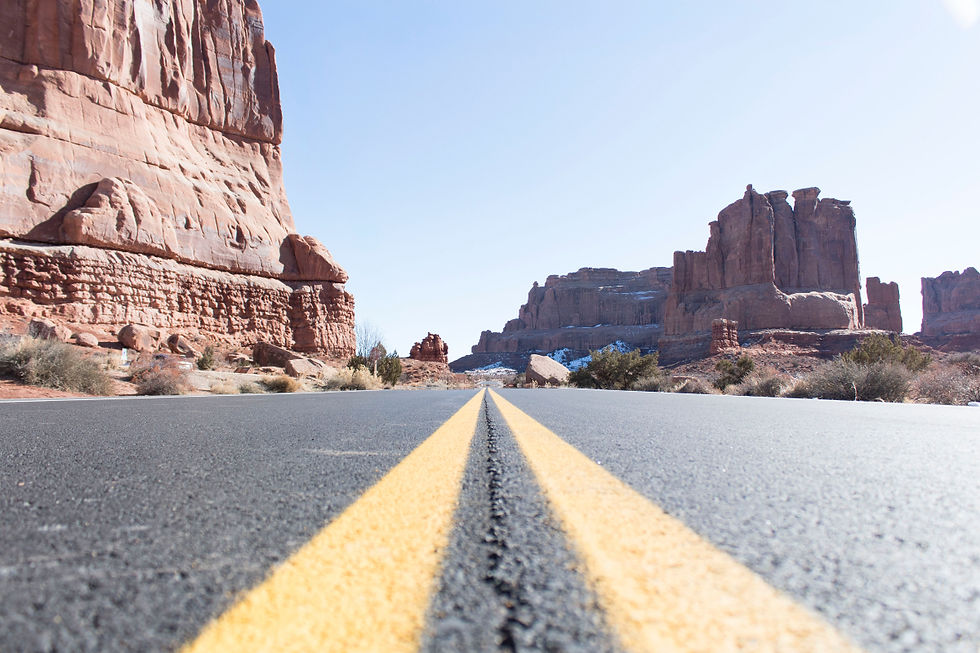
I’ve watched first‑timers treat the drives as “empty time” to cram with calls, podcasts, and planning for the next thing. By the time they reach their trailhead or overlook, they’ve already burned half their bandwidth. They hike with that same intensity, then tackle another long drive back to a noisy hotel right on Main Street where trucks run all night.
By the third day, they’re exhausted, and Moab becomes a blur they barely remember.
What I’ve learned, driving those roads since I was a kid, is that the space between places is part of the experience. The way the landscape unspools has its own rhythm if you let it: sagebrush to slickrock, cottonwoods to cliffs, mountains to mesas and back again.
But if you treat those road miles as something to “get through,” your trip starts to feel like a series of sprints with no recovery.
First Time Moab Visitor Mistake #4: Staying Only in Town
Most trip planners do the same thing: they pick Moab on the map, zoom in until they see hotels, and book something close to the main drag. It feels logical. You want to be “where the action is.”

But Main Street has its own personality—bright signs, semi-trucks barrelling through at all hours, revving engines, laughing and chating, people drifting from restaurant to bar and back again. For some folks, that’s fun. For others, especially families or people craving quiet, it’s a lot.
I’ve stayed in those roadside rooms. The walls vibrate when a semi roars past at 2 a.m. The hotel offers earplugs like an apology. Seriously. You wake up with the kind of hangover you get from too much noise, not too much drink.
First‑timers often tell me, “We loved the parks, but we didn’t sleep well. We didn’t really rest.”
It makes sense. You’ve just spent all day in vast, echoing spaces, letting your eyes drink in horizons. Ending that day pressed against a thin wall while someone revs a motorcycle outside is like finishing a symphony with a fire alarm.
That’s one of the reasons I built a base in Old La Sal in the first place: to offer a different ending to the story.
How a Deer Creek Retreat Basecamp Changes the Story for First Time Moab Visitors

This is where Old La Sal—this little shoulder of the La Sal Mountains with its trees and wind and long views—changes everything.
When you use Deer Creek as your mountain basecamp, the journey for a first time Moab visitor bends in quieter, more sustainable ways. You still get the arches, the canyons, the river.
But you also get:
Cool mornings where your nervous system remembers what “unrushed” feels like.
Midday escape routes when the heat, crowds, or kids start tipping from “fun” to “too much.”
Evening reset time under a sky that doesn’t know how to hurry.
Instead of four days of full‑throttle, imagine it like this:
Day 1: Landing
You wind up the road from Moab into Old La Sal, watching the world green up again. You step out of the car at Deer Creek and notice something you haven’t felt all day: a breeze that doesn’t taste like asphalt.
Inside the main cabin, kids claim beds and couches. Someone opens the front door and just stands there, staring at the view like it’s a painting. In the tiny home, a couple climbs the ladder to the loft and tests the mattress with the kind of relief that says, “We made it.”
That first night, you don’t rush back into town. You eat something simple, sit on the porch, and let your brain arrive.
Day 2: Arches with Margin
You wake earlier than you expected because the light in Old La Sal is honest, not filtered through streetlamps. Coffee on the porch, a quick check of the Arches entry system and weather, and then you’re on the road before the heat starts shouting.
You picked one or two hikes—maybe The Windows in Arches National Park and a shorter trail to a viewpoint—based on more than just pretty photos. You go in with extra water, downloaded maps, snacks, and the knowledge of where shade might be.
By late morning, when you feel that subtle shift toward “too much sun,” you don’t gut it out in the name of “making the most of it.” You turn the car back toward Old La Sal.
Lunch at the cabin. Kids fall asleep mid‑puzzle. One adult reads, the other stares out the window pretending to read. By late afternoon, if you feel like it, you take a short drive along a quiet road near the cabin, watching deer move through the trees while the town below deals with busy and heat and traffic.
Day 3: Canyon Day, With an Exit Strategy
Canyonlands and Dead Horse Point are big‑feeling places. The kind of vistas that make you feel small in a way that’s good for you.
You leave early again, this time knowing exactly how long the drive will take because you looked it up the night before and gave yourselves a buffer. You pack a picnic, more water than you think you need, and realistic expectations: you don’t have to stand at every viewpoint to have “done” the park.
After hours of big sky, the colorado river, and bigger cliffs, there’s a moment when everyone’s done being inspired and starts being tired. That’s your cue. You load up, point the car back to Old La Sal, and let the elevation and cooler air do its work.
You get back in time to see the last light slide off the La Sals from the porch. The day ends not with headlights and hotel hallways, but with stars and crickets.
Day 4: A Different Kind of Last Day
Instead of a frantic “one more big thing,” your last day might stay closer to the cabin. A slow morning, a short exploration on a forest road, a short trip up to Medicine Lake in the La Sals, or time along a creek or under tall pines. You leave with enough energy to drive safely, not just enough willpower to make it home.
That’s what a Deer Creek Retreat basecamp does for first‑timers: it doesn’t shrink your trip; it gives everything room to breathe.
Do This Instead: Gentle Corrections for First Time Moab Visitor Mistakes
If you’re planning your first Moab trip and recognizing yourself in any of this, here’s what I’d whisper to you while you’re still in the planning phase:
Instead of overstuffing the itinerary
Do this instead: Pick one “main thing” per day (one park, one big hike, one guided experience) and let the rest be flexible. Use the extra space for slow mornings, unscheduled evenings, or a midday retreat back to Old La Sal.
Instead of underestimating heat
Do this instead: Plan your longest, most exposed activities for the coolest parts of the day. Start earlier than feels natural, carry more water than feels reasonable, and treat shade like a scheduled activity, not an accident.
Instead of ignoring drive times
Do this instead: Treat the drives as part of the adventure. Factor in time for picture‑taking, bathroom stops, and just sitting in silence watching the landscape change. Add 30 minutes to every estimate and consider that your margin, not wasted time.
Instead of staying only in town
Do this instead: Sleep in the mountains. Let Moab be a place you visit, not the place that keeps you up at night. Use Deer Creek as your anchor—a quiet, dark, cool home base that makes the wildness easier to enjoy.
These might look like small adjustments. On the ground, they can be the difference between “We survived Moab” and “We can’t wait to go back.”
A Challenge: Make Your First Moab Trip a Story You Want to Repeat
If you’ve read this far, there’s probably a part of you that can already see your own crew here—dust on your shoes, park maps crumpled on the dashboard, a string of “remember when…” moments still forming.
So here’s the challenge: design this first Moab trip like you’ll actually want to come back.
Skip the race. Let go of the fantasy that you’ll “do everything” in three days. Instead, give yourselves enough space to actually feel the places you visit—and enough rest to remember them.
Block off the time. Put it on the calendar before something else claims it.
Book the main cabin if you want a true basecamp for your people: a long table for maps and snacks, couches for collapsing, a porch where mornings can start slow and evenings can stretch out. Book the tiny home if your version of a first trip is smaller and quieter—just a couple of you, a loft bed under the stars, and the sense that you’ve stepped sideways out of regular time.
Come build a different kind of first‑time Moab story:
Mornings on the porch, planning one good adventure instead of five.
Midday in the desert or by the river, with enough water, enough shade breaks, and enough honesty to turn around when it’s time.
Evenings back in Old La Sal, under a sky that will outlast every itinerary you ever make.
Let the high desert introduce itself slowly. Then carry that introduction back into your life—not as a blur, but as a memory you can actually feel in your bones.
Cheers!
Justin
The Deer Creek Retreat Prep & Field Guide Series
Part 1: Soul Care in the High Desert: How to Turn Your Moab Trip into a Mini Retreat
Part 2: Staying at Deer Creek Retreat: Best Things to Do in Moab and the La Sal Mountains
Part 3: Safety and Heat Prep for Your Moab-La Sal Mountain Retreat
Part 4: Old La Sal Basecamp: Practical Desert Survival Skills for First-Time Moab Visitors
Part 5: First Time Moab Visitor Mistakes (and How a Deer Creek Retreat Basecamp Fixes Them)
Part 6: Family Retreat Between Cabin and Canyon: Helping Kids Thrive in Moab and Old La Sal
Part 7: Planning to Pack for Old La Sal, Utah: Mountain Calm Meets Moab Adventure
🎒 Heading out on the trail? Don’t leave your safety to chance once cell service drops. Grab the High-Desert Survival Field Guide for critical hydration formulas, 12:00 PM lightning cutoffs, and slot canyon flood rules, or pick up the Mountain to Desert Guide to master route navigation, rapid elevation shifts, and the 10-essential gear audit.
About the Author
The author holds a Ph.D. and is an ordained professional chaplain, specializing in the integration of motivation and choice theory, psychological resilience, and pastoral soul care. Transitioning from a ten-year active duty career as a Chaplain in the U.S. Army—where he served within the high-intensity environment of a critical care hospital—his work bridges empirical behavioral science with practical strategies for long-term identity formation. He serves as the primary researcher for grittygritgrit.com, a digital platform dedicated to helping individuals cultivate authentic perseverance through the profound transitions, traumas, and valleys of life. You can explore more of his work and high-mountain-desert writing at deercreeklasal.com.


Comments